
The most common slip with S corp shareholder health insurance on the W-2 is leaving it off. Premiums the company pays for an owner with more than 2% of the stock belong in box 1 as wages, stay out of boxes 3 and 5, and must be reported in the same year the company pays them.
Miss that, and the owner can lose the self-employed health insurance deduction that makes the arrangement worth doing. The fix is a payroll entry, and it is far easier before the final 2026 payroll than after W-2s go out. Below, one hypothetical company is followed from the premium bills to the owner’s tax form, with the official wording for each step.
One owner, $14,400 of premiums, and a December payroll
Hypothetical example. Rowan Field Design Inc. is a four-person landscaping design firm taxed as an S corporation. Its founder owns 100% of the stock and pays herself a $72,000 salary through payroll, $6,000 a month, with no pre-tax deductions. Since January the company has paid a family health plan premium of $1,200 a month straight to the insurer, so the 2026 total will be $14,400.
Her payroll provider has been running her as an ordinary employee all year, so every pay stub shows $6,000 of wages and nothing about the premiums. That is normal. Most payroll systems only learn about owner premiums when someone tells them, which is why the entry usually happens in November or December as a one-time adjustment.
Personal use of a company car or van is another benefit that often reaches payroll only in December, though unlike these premiums its value also counts in boxes 3 and 5; the company vehicle W-2 walkthrough values four vehicles at one hypothetical service company.
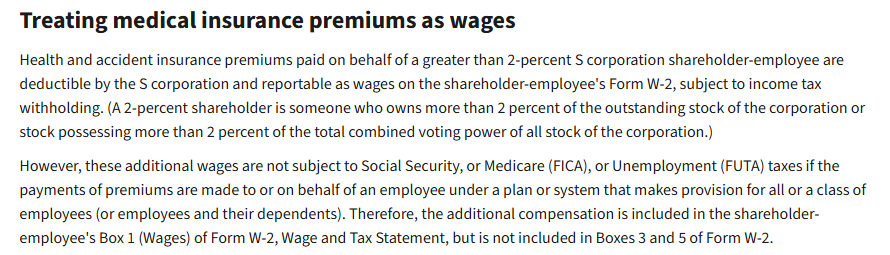
The IRS explains the treatment on its S corporation compensation and medical insurance issues page. As of November 15, 2026, the section titled “Treating medical insurance premiums as wages” says the premiums are deductible by the corporation and reportable as wages on the shareholder-employee’s Form W-2, subject to income tax withholding.
Who counts as a 2% shareholder
The label is slightly misleading. The rule reaches anyone who owns more than 2% of the outstanding stock, or more than 2% of the voting power, on any single day of the tax year. Publication 15-B (2026) adds that ownership can be direct or indirect and tells employers to treat such a shareholder like a partner for fringe benefit purposes.
Indirect ownership is where small companies get caught. Notice 2008-1 points to section 318, and section 318 treats a person as owning the stock held by a spouse, children, grandchildren and parents. So if the founder’s husband works part time for Rowan Field Design and owns no shares himself, he is still treated as owning her 100%, and any premiums the company pays for his own coverage get the same W-2 treatment. A rank-and-file employee who owns no stock and has no family tie to an owner is not affected and keeps the ordinary tax-free treatment of employer health coverage.
One more consequence surprises owners. The IRS page says a 2-percent shareholder-employee cannot join a QSEHRA, an HRA or other self-insured arrangement, or a section 125 flexible spending arrangement. Premium money for the owner runs through wages or not at all.
Running the $14,400 through each W-2 box
Here is how the hypothetical founder’s 2026 W-2 changes once payroll records the premiums. The 2026 General Instructions for Forms W-2 and W-3 list “the cost of accident and health insurance premiums for 2%-or-more shareholder-employees paid by an S corporation” among the items that go in box 1.
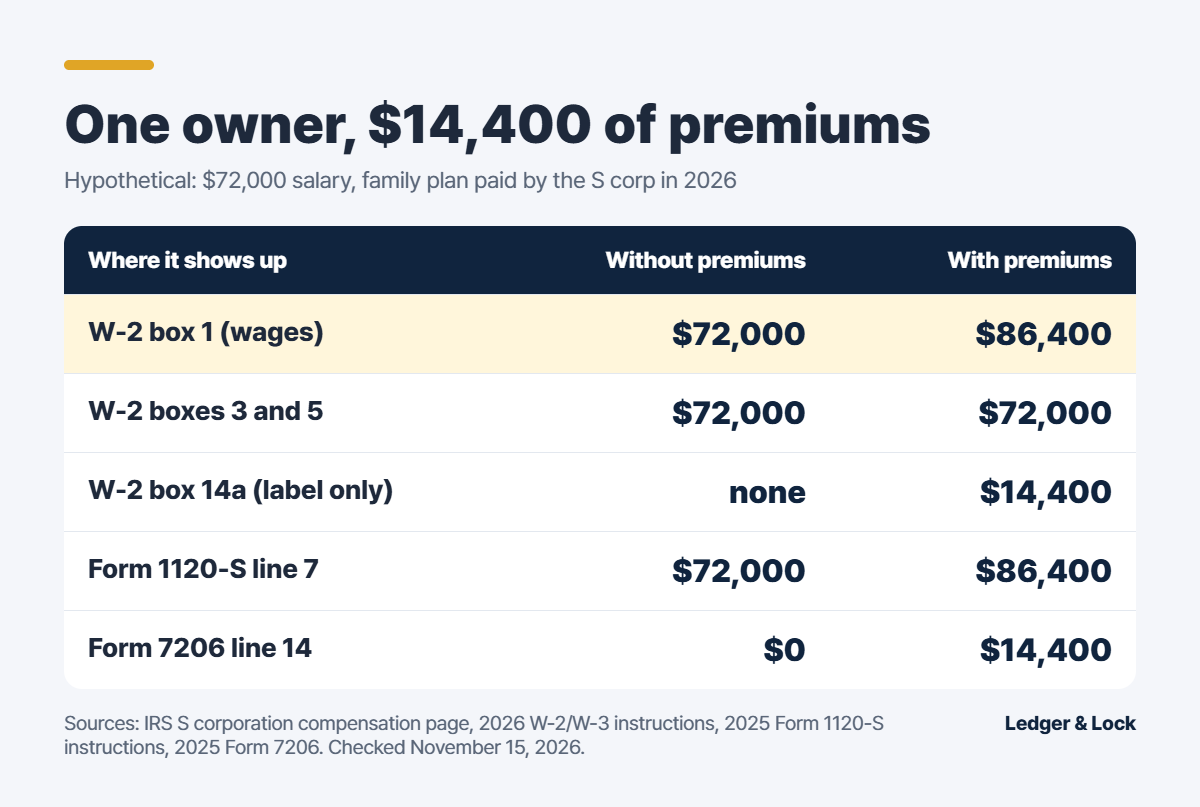
Box 1 rises from $72,000 to $86,400. Boxes 3 and 5 stay at $72,000, because the IRS excludes these premiums from Social Security, Medicare and FUTA wages when they are paid under a plan or system that covers all employees or a class of employees. Box 4 stays at $4,464 (6.2% of $72,000) and box 6 at $1,044 (1.45% of $72,000).
Compare that with paying the same $14,400 as extra salary. Social Security and Medicare at 7.65% would come to $1,101.60 from her and another $1,101.60 from the company, $2,203.20 in total, that the premium treatment does not trigger. FUTA makes no difference in her case, since her salary already passed the $7,000 FUTA wage base early in the year.
Income tax is a different story. Publication 15 (2026) says the value of health insurance benefits must be included in a 2% shareholder’s wages for income tax withholding. The same publication lets an employer either add a fringe benefit to regular wages for a pay period or withhold at the optional flat 22% supplemental rate; at 22%, $14,400 would mean $3,168 withheld. The holiday bonus withholding example shows how that flat-rate method looks on a real paycheck. Many owners instead cover the extra tax through the final estimated payment, which is a conversation for whoever prepares the personal return.
Two labels finish the form. The 2025 Form 1120-S instructions tell the corporation to report the premiums as an information item in box 14 of the shareholder’s W-2; on the 2026 form that box has been split, and general items now go in box 14a (“Other”), with box 14b reserved for the new tipped occupation codes described in our W-2 box 12 code TT and TP walkthrough. A short label such as “S corp health 14,400” is enough. On the corporate return, the premiums go on line 7 (officer compensation) or line 8 (salaries and wages), whichever fits the shareholder, and not on line 18, which is for benefits of owners at 2% or less.
Paid by the company in the same year, or no deduction
The W-2 entry only works if the money moved the right way. IRS Notice 2008-1 says the plan counts as established by the S corporation when the company pays the premiums in the current year, or when the shareholder pays, gives the company proof of payment, and the company reimburses her in the current year. The IRS page confirms that Notice 2015-17 still lets S corporations rely on Notice 2008-1.
“In order for the 2-percent shareholder-employee to deduct the amount of the accident and health insurance premiums, the S corporation must report the accident and health insurance premiums paid or reimbursed as wages on the 2-percent shareholder-employee’s Form W-2 in that same year.” IRS Notice 2008-1
The notice’s own first example is the failure case: a shareholder buys a policy in her own name, pays it herself, and the company never reimburses her. No plan is established by the S corporation, and no deduction is allowed. Policies in the owner’s name are fine; the IRS notes some states will not sell group coverage to a one-employee corporation. The reimbursement is what matters.
Home office costs follow a similar logic. Rent and utilities an owner pays personally become a tax-free company reimbursement only when they run through an accountable plan for S corp home office costs, with each expense documented within a reasonable period.
For 2026 that leaves a short calendar. Reimbursement has to land by Thursday, December 31, and in practice it should ride on the last 2026 payroll so the provider can add the premiums to box 1 in the same run. Christmas Day falls on Friday, December 25, so a payroll funded by ACH late that week may need to be approved a day or two earlier; the 2026 ACH bank holiday calendar lists the affected dates. W-2s are due to employees and to the Social Security Administration by February 1, 2027.
Where the owner claims it: Form 7206
The payoff shows up on the owner’s personal return. On the 2025 Form 7206, the latest final version on IRS.gov when checked on November 15, 2026, line 1 takes the premiums paid for coverage established under the S corporation, line 11 takes the Medicare wages from box 5 of the W-2 from that same S corporation, and line 14 is the smaller of the premiums or that wage figure. The result goes to Schedule 1 (Form 1040), line 17.
For the hypothetical founder, line 1 is $14,400 and line 11 is $72,000, so line 14 is $14,400. The limit matters when an owner pays herself a very small salary: box 5 wages below the premium total cap the deduction at those wages.
The month test can shrink it further. Form 7206 excludes premiums for any month the owner was eligible to join a subsidized health plan through her own other employer or her spouse’s employer, even if she declined it. Suppose the founder’s husband took a job elsewhere in October whose subsidized family plan she could have joined from October through December. Those three months, $3,600, come out of line 1, leaving $10,800. Her W-2 does not change: box 1 still shows $86,400, because the wage reporting and the personal deduction follow different rules.
Every step of this lands on the year-end close checklist, next to the bonus and 1099 work most owners are already doing in December.
What S corp owners ask about premiums on the W-2
What happens if S corp health insurance is not on the W-2?
The owner generally loses the deduction. Notice 2008-1 says the premiums must be reported as wages on the 2-percent shareholder’s W-2 in the same year; otherwise the plan is not established by the S corporation and no section 162(l) deduction is allowed. A W-2 already filed is fixed with Form W-2c; ask your preparer how a late correction is treated.
Does an S corp owner’s spouse count as a 2% shareholder?
Yes, in most cases. Section 318 treats a person as owning stock held by a spouse, children, grandchildren and parents, and Publication 15-B (2026) counts direct or indirect ownership of more than 2% on any day of the year. A spouse employed by the company therefore gets the same box 1 treatment for premiums.
Can a 2% shareholder use an HRA or QSEHRA?
No. The IRS S corporation compensation page says a 2-percent shareholder-employee is not eligible to participate in a QSEHRA, cannot join an HRA or other self-insured arrangement, and is not treated as an employee for a section 125 flexible spending arrangement. Premiums for the owner have to run through W-2 wages instead.
Is S corp shareholder health insurance subject to FUTA?
Not when the premiums are paid under a plan or system covering all employees or a class of employees. The IRS says those amounts are not subject to Social Security, Medicare or FUTA taxes, so they appear in W-2 box 1 only. Federal income tax withholding still applies, per Publication 15 (2026).
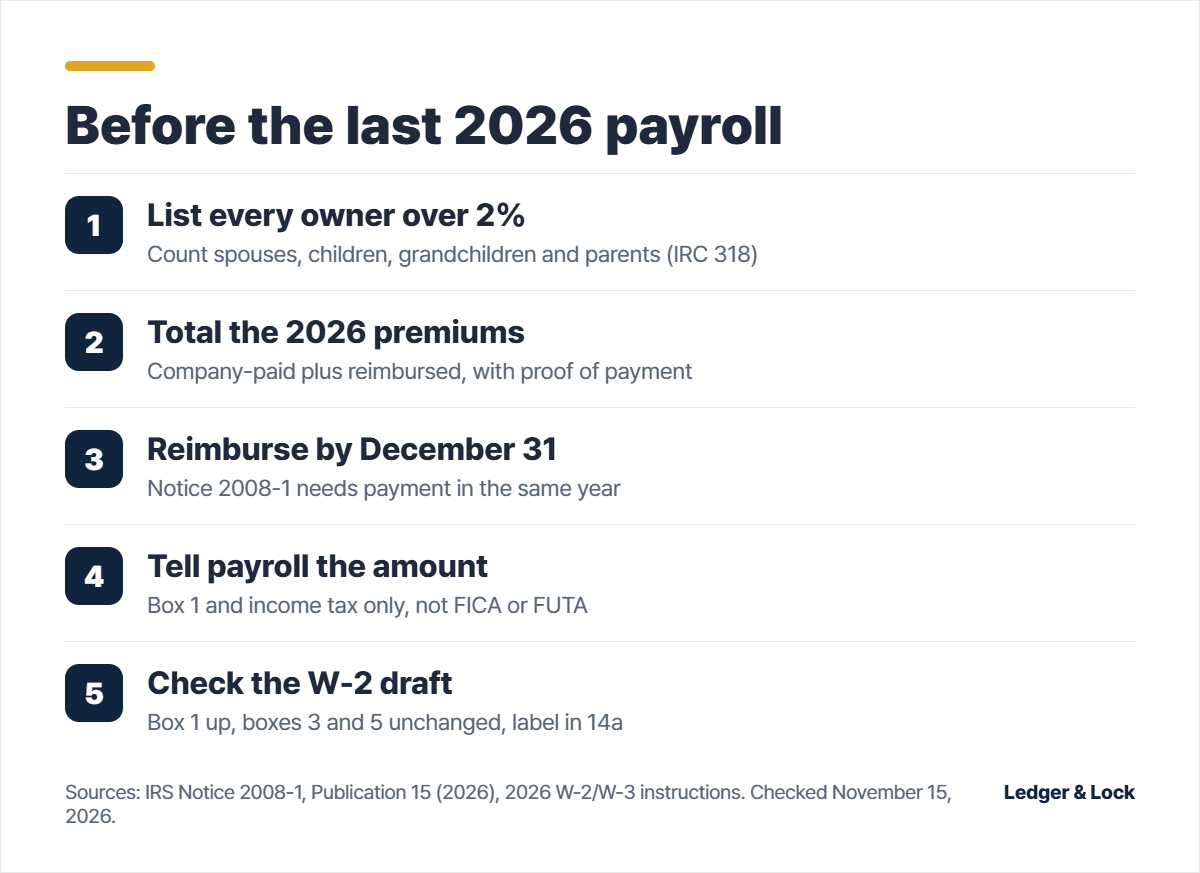
Before the payroll provider’s year-end cutoff, send it three things in writing: the name of each owner or family member over the 2% line, each person’s 2026 premium total split into company-paid and reimbursed amounts, and a request to add those amounts to box 1 and box 14a only. Then check the draft W-2 before it is filed and confirm boxes 3 and 5 did not move.
This article is general information drawn from the IRS S corporation compensation page, Notice 2008-1, the 2026 General Instructions for Forms W-2 and W-3, Publications 15 and 15-B (2026), the 2025 Instructions for Form 1120-S and the 2025 Form 7206 as published on November 15, 2026. It is not tax or legal advice and does not cover state income tax, C corporations, partnerships, or premium tax credit interactions. Ask a CPA or enrolled agent about your own facts, and check the 2026 Form 7206 on IRS.gov once it is released.
Leave a Reply