
The holiday bonus tax rate decides how much of a year-end bonus your staff actually take home and how much the gesture costs you. For 2026 the federal withholding rate on bonuses paid separately is a flat 22%, and Social Security and Medicare apply on top. A $500 check does not arrive as $500, and it costs you more than $500.
The 2026 numbers at a glance, each explained further down:
- Federal income tax withholding on a separately paid bonus: a flat 22%.
- Employee Social Security and Medicare: 7.65% combined, and you pay a matching 7.65%.
- A plain $500 bonus nets the employee $351.75 and costs the business $538.25 for a year-round employee past the FUTA wage base, before state unemployment tax.
- Grossing up so the check shows $500 takes a $710.74 gross bonus.
- Gift cards count as wages at any amount; small non-cash holiday gifts may not.
This guide follows one hypothetical business, a six-person bakery in a state with no income tax, through the numbers: the flat-rate math, a gross-up so each person nets an even $500, how gift cards and holiday gifts are treated, and the deposit and W-2 steps afterward. It covers federal rules for W-2 employees only. Your state may add its own withholding, and owners who are not on payroll are outside its scope.
S corporation owners who are on payroll have a different December task: if the company paid health insurance premiums for an owner with more than 2% of the stock, those premiums belong in box 1 of the owner’s W-2. The S corp shareholder health insurance W-2 guide shows the payroll entry to make before the last 2026 run.
Withholding rates and deposit rules on this page come from IRS.gov guidance checked October 20, 2026.

What the holiday bonus tax rate is in 2026
The IRS calls bonuses “supplemental wages,” the same bucket as commissions, back pay, and awards. According to IRS Publication 15 (2026), if you identify the bonus separately from regular wages and you withheld income tax from that employee’s regular pay this year or last year, you may withhold a flat 22% for federal income tax. The rate stayed at 22% because P.L. 119-21 permanently extended the individual rates from the 2017 tax law.
The aggregate method and the $1 million line
Two other paths exist. Pay the bonus inside a regular paycheck without splitting out the amount, and you withhold as if the total were one regular payment, using the tables in Pub. 15-T. That aggregate method can withhold more, because the payroll software treats the larger check as if the person earned that much every period. Once one employee’s supplemental wages from you pass $1 million in a calendar year, the excess must be withheld at 37%, whatever their Form W-4 says.
Whichever method you use for income tax withholding, Pub. 15 says the bonus is still subject to Social Security, Medicare, and federal unemployment (FUTA) tax.
FICA and FUTA on top
For 2026, Social Security is 6.2% from the employee and 6.2% from you, on wages up to $184,500 per person. Medicare is 1.45% each with no cap, plus an extra 0.9% withheld from the employee only on wages above $200,000. FUTA is 6.0% on the first $7,000 of each employee’s annual wages, and employers who pay their state unemployment tax in full and on time can usually take a credit of up to 5.4%, which leaves 0.6%.
That 0.6% assumes your state is not on the Labor Department’s credit reduction list. For 2026 the only state on it is California, at 1.5%, so a California employee who reaches $7,000 in wages costs $105 more in FUTA; what the 2026 FUTA credit reduction adds per employee walks through the Form 940 entries.
What six $500 bonuses cost a hypothetical bakery
Juniper Street Bakery is made up. It has five year-round employees, each well past $7,000 in 2026 wages, and one seasonal counter worker hired in November who has earned $1,800 so far. The owner wants to give everyone $500 on December 12 as a separate check and uses the flat-rate method.
- Federal income tax: $500 × 22% = $110.00 withheld.
- Employee Social Security: $500 × 6.2% = $31.00 withheld.
- Employee Medicare: $500 × 1.45% = $7.25 withheld.
- Net check: $500 − $110.00 − $31.00 − $7.25 = $351.75.
- Employer share: another $31.00 Social Security plus $7.25 Medicare, so $538.25 per bonus.
- FUTA for the seasonal worker only: her wages stay under $7,000, so $500 × 0.6% = $3.00. The other five owe no more FUTA this year.
Added up across all six employees, the bonus run looks like this:
- Federal income tax withheld (22%): $110.00 per bonus, $660.00 for all six.
- Employee FICA withheld (7.65%): $38.25 per bonus, $229.50 for all six.
- Net paid to employees: $351.75 each, $2,110.50 in total.
- Employer FICA (7.65%): $38.25 per bonus, $229.50 for all six.
- FUTA: $3.00, for the seasonal worker only ($0 for the other five).
- Total cash out of the business: $538.25 to $541.25 per bonus, $3,232.50 for all six.
So $3,000 of bonuses costs the bakery $3,232.50 before state unemployment tax, and employees see about 70% of the headline number. Note what the 22% is: withholding. The employee’s actual income tax is settled on their own return, so some will get part of it back and some will owe a little more.
To run the same flat-rate math for one of your employees, including the Social Security cap and an optional state rate, use the calculator below.
Bonus withholding calculator (2026, flat-rate method)
For a bonus paid to a W-2 employee as a separately identified amount, when you withheld income tax from that person’s regular pay this year or last year. Enter their 2026 wages from you before the bonus so the Social Security cap, Additional Medicare and FUTA limits land in the right place.
Basis: IRS Publication 15 (2026). Federal income tax: optional flat 22% on supplemental wages identified separately, and a mandatory 37% on the part of an employee’s 2026 supplemental wages from you above $1,000,000. Social Security: 6.2% from the employee and 6.2% from you, on wages up to the 2026 wage base of $184,500 (SSA contribution and benefit base). Medicare: 1.45% each with no cap, plus 0.9% Additional Medicare Tax withheld from the employee only on wages you pay above $200,000 in the calendar year. FUTA: 0.6% on the first $7,000 of each employee’s wages, assuming the full 5.4% state credit. Rates as of Oct 24, 2026. Each line is rounded to the nearest cent; a gross-up uses the smallest gross amount whose net reaches your target. Not covered: the aggregate method (bonus combined with regular pay and withheld with the Pub. 15-T tables), state rules other than one flat rate, local taxes, state unemployment tax, FUTA credit reduction states, pre-tax deductions such as 401(k), and wages from other employers. The 22% is withholding; the employee’s actual tax is settled on their return. Estimate only.
How we checked this calculator
We ran these numbers on Nov 25, 2026: four hypothetical bonuses worked out by hand from IRS Publication 15 (2026) (22% flat rate, 37% above $1 million, 6.2% and 1.45% FICA, 0.9% Additional Medicare Tax, 0.6% FUTA) and the 2026 wage base of $184,500 on SSA’s contribution and benefit base table, then entered into the calculator above. The gross-up example in the next section ($710.74 for a $500 net check) also matched to the cent.
| Hypothetical inputs | Official-rule result | Calculator result |
|---|---|---|
| Hypothetical 1: $500 bonus, $1,800 paid before it | Net $351.75; employer cost $541.25, including $3.00 FUTA | Net $351.75; employer cost $541.25 |
| Hypothetical 2: $10,000 bonus, $180,000 paid before it (crosses the wage base) | Social Security only on the last $4,500: $279.00; net $7,376.00 | $279.00; net $7,376.00 |
| Hypothetical 3: $30,000 bonus, $190,000 paid before it | No Social Security; Additional Medicare $180.00 on $20,000 over $200,000; net $22,785.00 | $0.00; $180.00; net $22,785.00 |
| Hypothetical 4: $200,000 bonus, $250,000 paid before it, $900,000 in earlier bonuses | Federal $59,000.00 ($100,000 at 22% plus $100,000 at 37%); net $136,300.00 | $59,000.00; net $136,300.00 |
What it does not cover: the aggregate method with the Publication 15-T tables, state rules beyond one flat rate, local taxes, pre-tax deductions such as 401(k), and wages from other employers.
How to gross up a bonus so the check shows $500
Many owners want the check itself to show the round number. That means grossing up: paying a larger gross amount so the net lands where you want it. With a flat 22% plus 7.65% FICA, the employee keeps 70.35% of every gross dollar, so you divide by 0.7035.
- Divide the target net by the keep rate: $500 ÷ 0.7035 = $710.73.
- Run the withholding on $710.73: $156.36 + $44.07 + $10.31 leaves $499.99, one cent short because of rounding. Round the gross up to $710.74 and the net becomes $500.00.
- Add your employer FICA of $44.07 + $10.31, for $765.12 per employee.
- For six people that is $4,590.72, plus $4.26 FUTA on the seasonal worker (0.6% of $710.74), or $4,594.98 total.
The gross-up costs the bakery $1,362.48 more than the plain $500 bonuses. Add any state income tax rate to the divisor before you run it; in a state that withholds, the keep rate drops and the gross amount rises. If your payroll tool has a gross-up or net-to-gross setting, it will do this division for you; otherwise run it by hand and check the net before approving.
Still choosing a payroll tool before the bonus run? The Gusto vs QuickBooks payroll pricing breakdown lists the monthly base and per-employee fees each vendor published in October 2026.
Gift cards, holiday gifts, and the overtime catch
Which gifts count as wages
A gift card feels like a gift, but the IRS treats it as cash. Publication 15-B (2026) says cash and cash-equivalent benefits, including gift certificates, gift cards, and the use of a charge or credit card, “no matter how little, are never excludable as a de minimis benefit.” A $25 coffee card belongs on the payroll register just like a check.
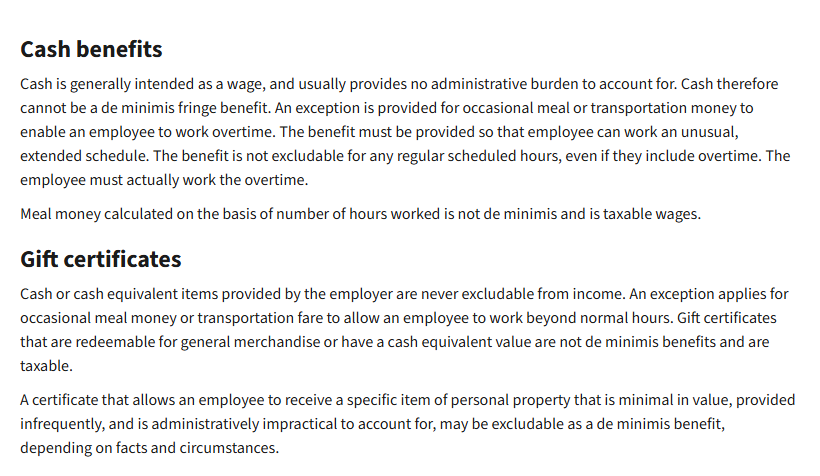
As of October 20, 2026, the IRS de minimis fringe benefits page lists “Holiday gifts” as a possible de minimis item and adds that if a benefit is too large to count, the whole value becomes taxable, not just the part above a limit. It also notes the IRS once ruled that items worth more than $100 could not be de minimis. Pub. 15-B gives the safe examples: holiday or birthday gifts other than cash with a low fair market value, and occasional parties or picnics for employees and guests.
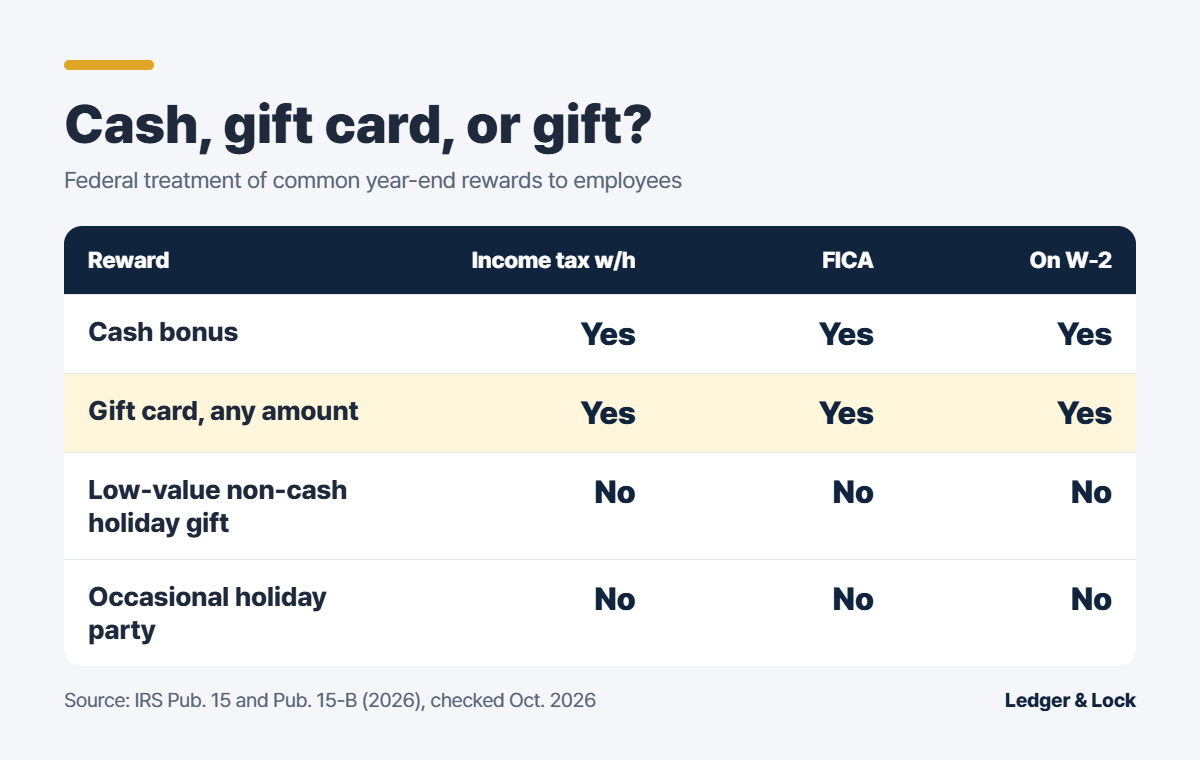
A gift card handed out between payrolls still goes on the next payroll at face value, with withholding taken from that check. Taxable fringe benefits can use the same optional 22% flat rate as bonuses, per Pub. 15.
The same card sent to a client is not wages at all. It is a business gift, and the client gift deduction limit of $25 per person decides how much of it the business can deduct.
The overtime catch for hourly staff
Federal wage law has its own rule. The Department of Labor’s Fact Sheet #56C says a bonus stays out of an hourly worker’s “regular rate” (the base for overtime pay) only if it is truly discretionary: you decide whether to pay it and how much at or near the end of the period, and it is not paid under a prior promise that leads employees to expect it.
Gifts on holidays or special occasions can also stay out of the regular rate, but only when the amount is not measured by hours worked, production, or efficiency (DOL Fact Sheet #56C).
Holiday pay follows a different rule from a holiday gift. A paid Christmas day off is pay for hours not worked, so the FLSA leaves it out of the 40-hour count; the explainer on whether holiday pay counts toward overtime covers the cases where a holiday premium changes that.
A flat $500 for everyone fits that description. A bonus announced in January as “$1 per hour worked, paid in December” does not, and you may owe extra overtime for weeks when that worker went past 40 hours. Already promised a formula? Talk to a payroll provider or employment attorney before the payout.
Overtime also has a new line on the 2026 Form W-2: qualified overtime pay is reported in box 12 with code TT. Our guide to what employers report in W-2 box 12 codes TT and TP shows which overtime counts.
Running the bonus payroll, then depositing and reporting
- Run it as an off-cycle or supplemental payroll with the bonus amount labeled separately, so the flat-rate method is available.
- Deposit the taxes on your normal schedule. Monthly depositors pay by the 15th of the following month, so December bonuses are due by January 15. Semiweekly depositors have at least three business days after the semiweekly period closes. A single day with $100,000 or more in accumulated tax liability triggers a deposit due the next business day.
- Report it on Form 941 for the fourth quarter alongside regular wages.
- Include it on Form W-2 in wages for income tax, Social Security, and Medicare. W-2s go to employees by January 31, moved to the next business day when that date falls on a weekend.
Year-end bonuses also feed the books you close in December. The cash goes out in one month and the tax deposit in the next, so plan the cash for both dates. Our year-end bookkeeping checklist walks through reconciling payroll accounts before you close the year. Independent contractors do not get bonuses through payroll; a thank-you payment to a contractor counts toward their 1099-NEC total instead, covered in how to prepare 1099-NECs for 2026.
To see where the bonus run falls among the other year-end jobs, from locking the books to the February 1, 2027 W-2 and 1099-NEC deadlines, follow the small business year end checklist.
Holiday bonus payroll checklist

- Decide whether the bonus is discretionary, and avoid hour- or sales-based formulas for hourly staff unless you will recalculate overtime.
- Pay the bonus as a separately identified amount if you want the 22% flat federal rate.
- Look up your state revenue department’s rule for withholding on supplemental wages.
- Decide on gross or net amounts, and gross up any amount promised as a net figure.
- Put every gift card through payroll as wages, whatever the amount.
- Keep non-cash holiday gifts small and occasional if you want them to stay tax-free.
- Note the deposit due date and the January 31 W-2 deadline on your calendar.
Are holiday bonuses taxed differently from regular pay?
The tax owed is the same, because a bonus is ordinary wages. What differs is withholding. The flat 22% can be higher or lower than the rate on a person’s regular paycheck, and the difference is reconciled when they file their return.
Can I pay a bonus with the regular paycheck?
Yes. Combine it with regular wages and specify each amount, and the 22% flat rate is still available. Combine them without specifying the amounts, and you must withhold on the total as one regular payment. Pub. 15’s own example: a $1,000 bonus paid separately under the flat rate means $220 of federal withholding.
Your next step: open your payroll tool, create a test off-cycle run for one employee with a $500 bonus, and compare the net to $351.75 (or to your state-adjusted figure) before you announce amounts to the team.
This article is general information about federal payroll rules as of October 2026, not tax, legal, or accounting advice for your business. Confirm current rules in IRS Publication 15 and your state revenue department, or ask a payroll professional.
Leave a Reply