

The FUTA credit reduction states for 2026 come down to one: California, at 1.5%. The Labor Department’s final list, updated November 10, 2026, drops the U.S. Virgin Islands because it repaid its federal loan in time.
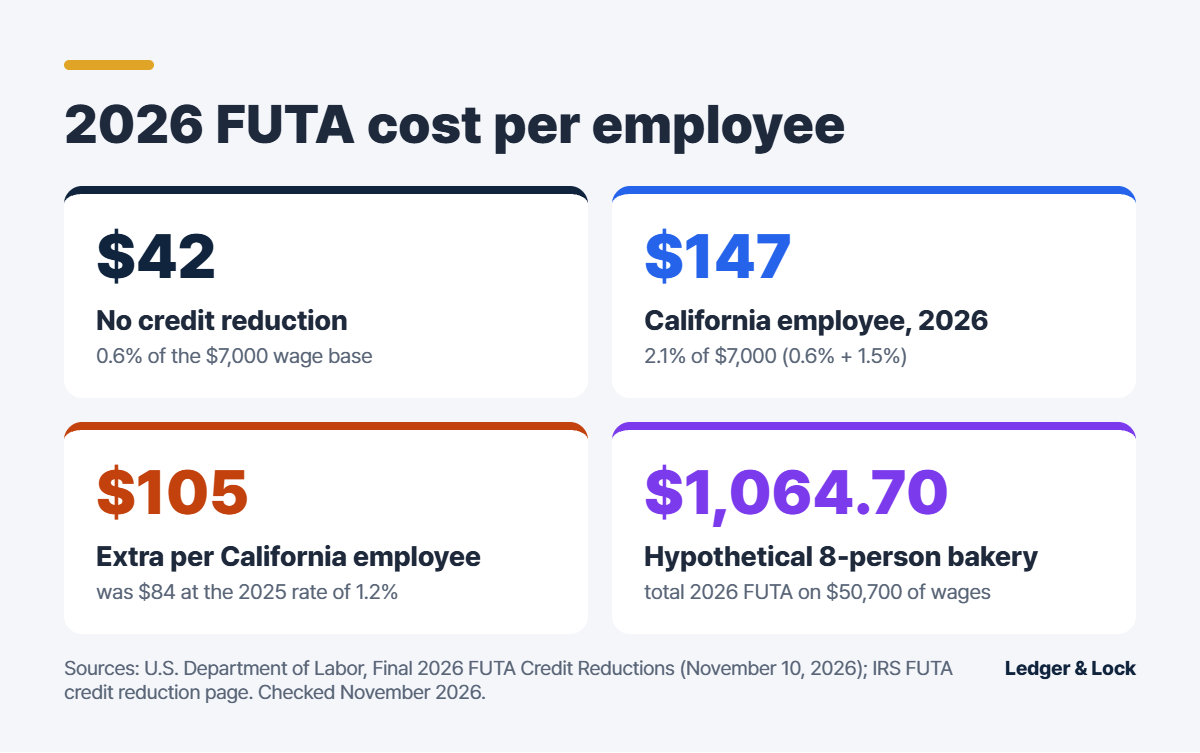
For a California employer, that turns the usual 0.6% federal unemployment tax into 2.1% on the first $7,000 of each employee’s wages: $147 per person instead of $42. The extra amount covers every California paycheck from January on, and the IRS treats it as fourth-quarter tax, so it lands in the deposit and Form 940 due at the start of February 2027. Employers with no California payroll keep paying 0.6%, provided their own state unemployment tax was paid in full and on time.
Rates below come from the Department of Labor’s Final 2026 Credit Reductions file and its 2010 to 2025 history file, both downloaded November 13, 2026. Filing rules come from IRS pages read the same day.
What the final 2026 FUTA credit reduction list says
A state lands on the list when it borrowed from the federal unemployment trust fund, still owed money on January 1 of two years in a row, and did not repay everything before November 10 of the second year. The IRS credit reduction page explains the schedule: 0.3% for the first year, another 0.3% for each later year the loan stays open, plus possible add-ons after the third and fifth years.
California owed money on every January 1 from 2021 through 2026. Its sixth year carried a potential “BCR add-on” of 3.5%, which would have pushed the reduction to 5.0%, but the DOL file says California applied for a waiver and was found eligible. That leaves the base 1.5%. The Virgin Islands had owed money every January 1 since 2010; the same file marks its advance as repaid before November 10, so its 2026 reduction is zero.
The table puts the last five years side by side, using the DOL history file for 2022 through 2025 and the final file for 2026. It is the comparison the IRS form instructions do not show in one place.
| Tax year | California | U.S. Virgin Islands | New York |
|---|---|---|---|
| 2022 | 0.3% | 3.6% | 0.3% |
| 2023 | 0.6% | 3.9% | 0.6% |
| 2024 | 0.9% | 4.2% | 0.9% |
| 2025 | 1.2% | 4.5% | None |
| 2026 (final) | 1.5% | None, repaid before November 10 | None |
Connecticut and Illinois also appear for 2022 at 0.3% and then drop off. No other state has a 2026 reduction.
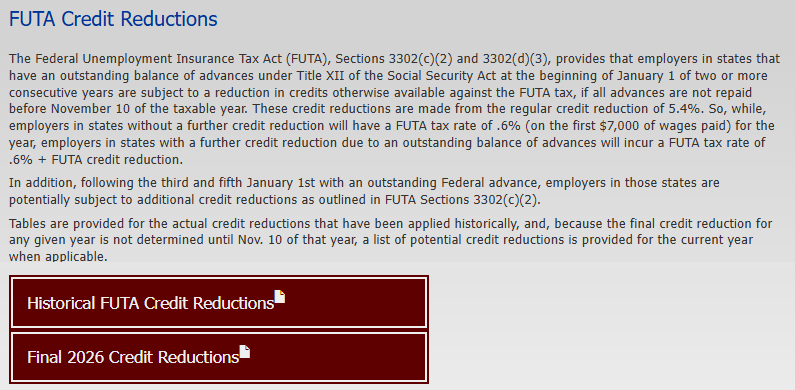
On the DOL FUTA Credit Reductions page as of November 13, 2026, the two maroon buttons under the explanation read “Historical FUTA Credit Reductions” and “Final 2026 Credit Reductions.” Both open spreadsheets. The 2026 file’s first line reads “Updated: November 10, 2026,” and its last column, “Final 2026 FUTA Credit Reduction,” is the number that goes on Schedule A.
Start with where you paid state unemployment tax
The credit reduction follows the state whose unemployment law covered the wages, which is the state you paid unemployment tax to. Where the company is incorporated or where the owner lives does not decide it. Pick the line that matches your 2026 payroll.
You paid unemployment tax only outside California
Nothing changes for 2026. Your net FUTA rate stays 0.6%, or $42 for each employee who reaches the $7,000 wage base, as long as your state tax was paid in full by the due date of Form 940 (IRS Topic 759 lists that as a condition of the full 5.4% credit). A multi-state employer still checks line 1b and files Schedule A to list its states, but with no California wages there is no extra amount.
Your whole payroll is in California
You are a single-state employer that still needs Schedule A. Enter “CA” on line 1a of Form 940, check the line 2 box for wages paid in a credit reduction state, and fill in Schedule A with your California FUTA taxable wages. Single-state employers in a credit reduction state use the schedule too, according to the IRS, and that is the step people miss when they have never filed it before.
You have staff in California and in other states
Check line 1b, check every state where you paid unemployment tax on Schedule A, and enter wages only for California. A business with three employees in Nevada and two in California pays the extra 1.5% on the two California employees’ FUTA wages and nothing extra on the Nevada three.
Your employees work in the Virgin Islands
Your 2026 Form 940 has no credit reduction for them, after 4.5% on the 2025 return. If your payroll system was accruing a Virgin Islands rate all year, the accrual should come down to the regular 0.6% before the fourth-quarter deposit.
Some wages were exempt from state unemployment tax
FUTA wages that California’s unemployment law excludes are not subject to the credit reduction, the IRS page says. They are handled on line 9 or line 10 of Form 940 instead, often at a higher rate, so read the line 10 worksheet in the Form 940 instructions before assuming those wages are cheaper.
What 1.5% adds per California employee
The math has one moving part. FUTA starts at 6.0% of the first $7,000, the normal credit is 5.4%, and California’s 2026 credit is 5.4% minus 1.5%, or 3.9%. What is left is 2.1%. For an employee who earned at least $7,000, that is $147 of federal unemployment tax, $105 more than an employer pays in a state without a reduction. For 2025 the gap was 1.2%, or $84 per employee.
Take a hypothetical bakery in Sacramento with eight employees on its California payroll. Six were full-time all year and passed $7,000 by spring. Two holiday hires started in October and will earn $3,200 and $5,500 by December 31. FUTA taxable wages are 6 × $7,000 + $3,200 + $5,500 = $50,700.
- Regular FUTA at 0.6%: $50,700 × 0.006 = $304.20
- Credit reduction at 1.5%: $50,700 × 0.015 = $760.50
- Total 2026 FUTA: $1,064.70, which is 2.1% of $50,700
At the 2025 rate the same payroll would have carried a $608.40 credit reduction, so the year-over-year increase is $152.10. Most of the bill is set by the six full-timers whose wages passed the base months ago; the holiday hires add only their actual pay. Owners who handed out year-end gifts can also check the holiday bonus tax rate walkthrough, which shows how an employee past the FUTA wage base changes the cost of a bonus.
Only employees count. Payments to independent contractors are not FUTA wages, which is one more reason the contractor vs employee classification mistakes matter at year end: a worker reclassified as an employee brings FUTA, and in California the higher rate, back with them.
FUTA is a small slice of the total. Across workplaces under 50 people, all legally required costs (Social Security, Medicare, federal and state unemployment and workers’ compensation) came to 10.7% of wages in June 2026 BLS data, as our breakdown of what an employee costs beyond salary shows by industry.
The extra tax belongs to the fourth quarter
Even though the reduction applies to wages paid since January, you do not go back and amend earlier deposits. On timing, the IRS credit reduction page is plain:
“Any increased FUTA tax liability due to a credit reduction is considered incurred in the fourth quarter and is due by January 31 of the following year.” (IRS, FUTA credit reduction page)
The Form 940 instructions add that you may deposit the expected extra amount during the year, but it is not due until the fourth-quarter deposit date. For 2026 work, January 31, 2027 is a Sunday. A deposit or filing deadline that falls on a weekend or a District of Columbia legal holiday moves to the next business day under IRS rules, which makes it Monday, February 1, 2027. The 2026 Form 940 instructions had not been posted when this was checked, so confirm the date there once they are out.
The $500 test then decides how you pay. If fourth-quarter FUTA, plus anything carried from earlier quarters, is more than $500, it must be deposited by electronic funds transfer (EFTPS, IRS Direct Pay for businesses, or your IRS business tax account). If it is $500 or less, you can deposit it or pay it with the return. The Sacramento bakery’s fourth quarter holds $52.20 of regular FUTA on the holiday hires’ $8,700 plus the $760.50 reduction, $812.70 in all, so it has to deposit.
Where it goes on Form 940 and Schedule A
On Schedule A, every state has a checkbox and, for credit reduction states, a box for FUTA taxable wages. For tax year 2026 only California’s wage box produces a number. Multiply the wages by the rate printed next to it on the 2026 schedule, add up the results, and carry the total to Form 940, line 11. Line 12 then adds lines 8 through 11, and when line 12 is more than $500, Part 5 splits it by quarter, with the credit reduction inside line 16d for October through December.
One check is worth doing before you sign: line 12 minus what you deposited (line 13) should equal your balance due, and the fourth-quarter figure in 16d should include the reduction. A return where 16d holds only 0.6% of fourth-quarter wages usually means the reduction was added to the total but not to the quarter. The 2025 Schedule A PDF shows the layout; the 2026 version will carry the new rate.
Two other ways to lose part of the 5.4% credit
The California reduction is set by the Labor Department, but two other credit losses come from your own payroll records, and they stack on top of it.
First, late state tax. Topic 759 says the full credit requires state unemployment tax paid in full, by the due date of Form 940, on the same wages that are subject to FUTA. State tax paid after that date is figured on the line 10 worksheet at a reduced credit. If a California quarterly payment to the EDD is still outstanding, paying it by February 1, 2027 protects the credit.
Second, wages left out of state tax. If some FUTA wages were excluded from state unemployment tax, the Form 940 instructions send you to line 10, and if all of them were excluded, line 9 applies the full 6.0% rate with no credit at all. Neither case is common for a small shop, but both show up after an entity change or when an owner-officer is on payroll.
What California employers ask about the 2026 FUTA credit reduction
Is New York a FUTA credit reduction state for 2026?
No. New York had credit reductions of 0.3%, 0.6% and 0.9% for 2022 through 2024, but the Department of Labor history file shows none for 2025, and the final 2026 list names only California. New York employers who paid state unemployment tax in full and on time use the regular 0.6% net FUTA rate.
How is the FUTA credit reduction calculated?
Multiply the FUTA taxable wages you paid under a credit reduction state’s unemployment law by that state’s rate on Schedule A (Form 940). For California in 2026 the rate is 1.5%, so an employee who earned at least $7,000 adds $105. The total goes on Form 940, line 11, according to the IRS instructions.
When did the FUTA credit reduction start for California?
The current run started with tax year 2022 at 0.3% and grew by 0.3% a year to 1.5% for 2026, according to Department of Labor files. California also had an earlier run from 2011 through 2017 that reached 2.1%. The reduction ends once the state repays its federal loan before November 10 of a year.
Dates for the payroll calendar between now and February
Three dates cover the whole job, and each one has a single task attached.
Before the last payroll of 2026: pull a year-to-date report of FUTA taxable wages by state. Count how many California employees reached $7,000 and add the partial wages of the rest. That total times 1.5% is the amount to set aside now, so the February deposit does not come out of January’s operating cash.
Monday, February 1, 2027: fourth-quarter FUTA deposit, including the credit reduction, and the Form 940 due date. Form 941 for the fourth quarter and the W-2 and 1099-NEC filings share the same week; the small business year-end checklist lays them out in order.
Wednesday, February 10, 2027: the later Form 940 filing date that the IRS allows only if every FUTA deposit was made on time. It does not move the payment date.
If your payroll provider files Form 940 for you, the first task is still yours: open the year-to-date FUTA wage report, confirm California wages appear in their own line, and ask the provider whether its fourth-quarter calculation uses the 1.5% final rate from the November 10 list.
This article is general information based on the Department of Labor’s FUTA credit reduction files, the IRS FUTA credit reduction page, IRS Topic 759 and the 2025 Instructions for Form 940 as published on November 13, 2026. It is not tax or legal advice and does not cover household or agricultural employers, successor employers, or California state payroll taxes. Check the 2026 Form 940 and Schedule A instructions on IRS.gov, or ask a payroll professional, before you file.
Leave a Reply