
How much does an employee cost beyond salary? At private workplaces with fewer than 50 workers, the answer in the latest federal data is about 35 cents on top of every wage dollar. The Bureau of Labor Statistics measured $27.88 in wages and $9.76 in benefits for each hour worked in June 2026, a total of $37.64. Large employers spend far more on benefits, so the national averages you see quoted (around 43 cents per wage dollar) overstate what a 6-person shop usually carries.
We downloaded BLS ECEC Table 6 (June 2026, released September 9, 2026) and the same table from the June 2025 release on November 25, 2026, and computed every ratio below from the published dollar figures.
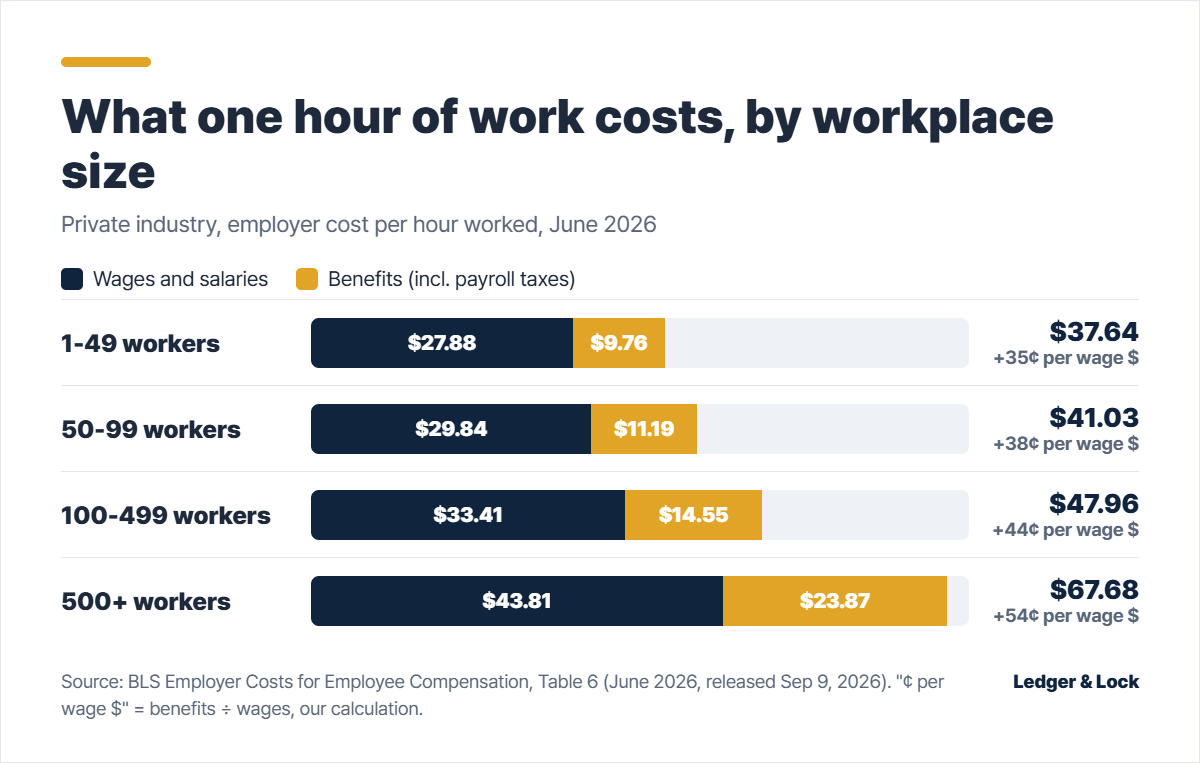
How much does an employee cost beyond salary at each workplace size
Table 6 splits private industry by establishment size, which BLS counts per physical location. At 1-49 workers, benefits came to $9.76 an hour against $27.88 in wages, or 35 cents per wage dollar. At 50-99 workers it was 38 cents, at 100-499 workers 44 cents, and at 500 or more workers 54 cents ($23.87 of benefits on $43.81 of wages). The gap is mostly insurance, paid leave and retirement: a 500-worker site paid $6.47 an hour for insurance, while a site under 50 paid $2.35.
That makes the common “add 30% to salary” shortcut a fair starting point for a small employer, but only as an average. Benefits were 25.9% of total compensation at 1-49 workers. Expressed against wages, which is how most owners budget, the same number becomes 35%.
For workplaces under 50 people, the federal average was $1.35 of total cost for every $1.00 of wages in June 2026. Your own number moves with the benefits you choose, but payroll taxes set a floor you cannot skip.
Payroll taxes are a bigger share of the bill at small shops
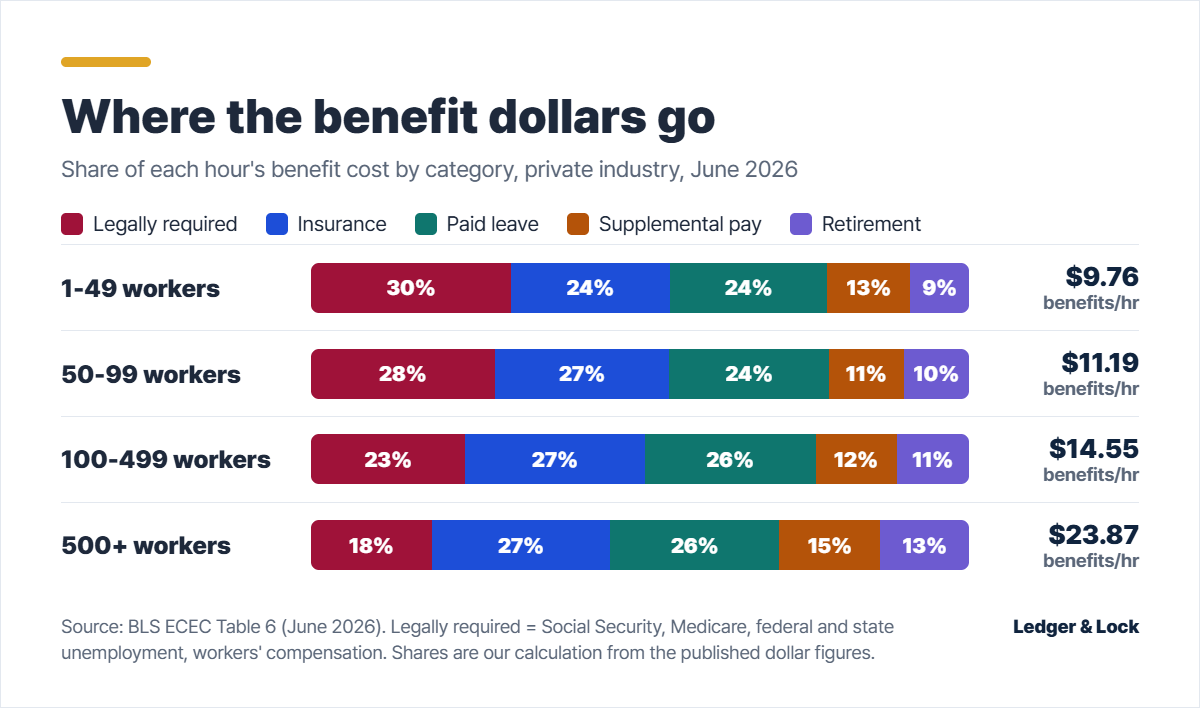
Legally required benefits (Social Security, Medicare, federal and state unemployment insurance, and workers’ compensation) cost $2.97 an hour at 1-49 workers. That is 30% of all benefit spending at small sites, compared with 18% at sites with 500 or more workers. Put another way, legally required costs alone equal 10.7% of wages at small workplaces, before any health plan or paid time off.
Most of that floor is fixed by statute. The employer pays 6.2% Social Security tax and 1.45% Medicare tax on wages, per IRS Topic 751, with Social Security stopping at the $184,500 wage base for 2026. Federal unemployment tax is 6.0% on the first $7,000 of each employee’s wages, usually reduced to 0.6% ($42 a year) by the state credit, as IRS Topic 759 explains. Employers in a state that owes the federal loan fund pay more; our note on FUTA credit reduction states for 2026 shows the extra per employee. State unemployment and workers’ compensation rates vary by state, claims history and job type, which is why the 10.7% average is a benchmark and not a rate you can file with.
What changed between June 2025 and June 2026
At 1-49 workers, total cost per hour rose from $35.85 to $37.64 (up 5.0%). Wages rose 4.0%, from $26.82 to $27.88, while benefits rose 8.0%, from $9.04 to $9.76. The fastest-growing piece was insurance, up from $2.05 to $2.35 (14.6%). Supplemental pay such as overtime and bonuses went from $1.08 to $1.23, and if you are planning a year-end payout, our breakdown of the holiday bonus tax rate shows how withholding works on top of that cost. Treat these year-over-year moves as direction, not a precise inflation rate: ECEC averages also shift when the mix of jobs in the sample shifts, and BLS publishes the Employment Cost Index, which holds that mix fixed, for tracking change.
What your industry changes
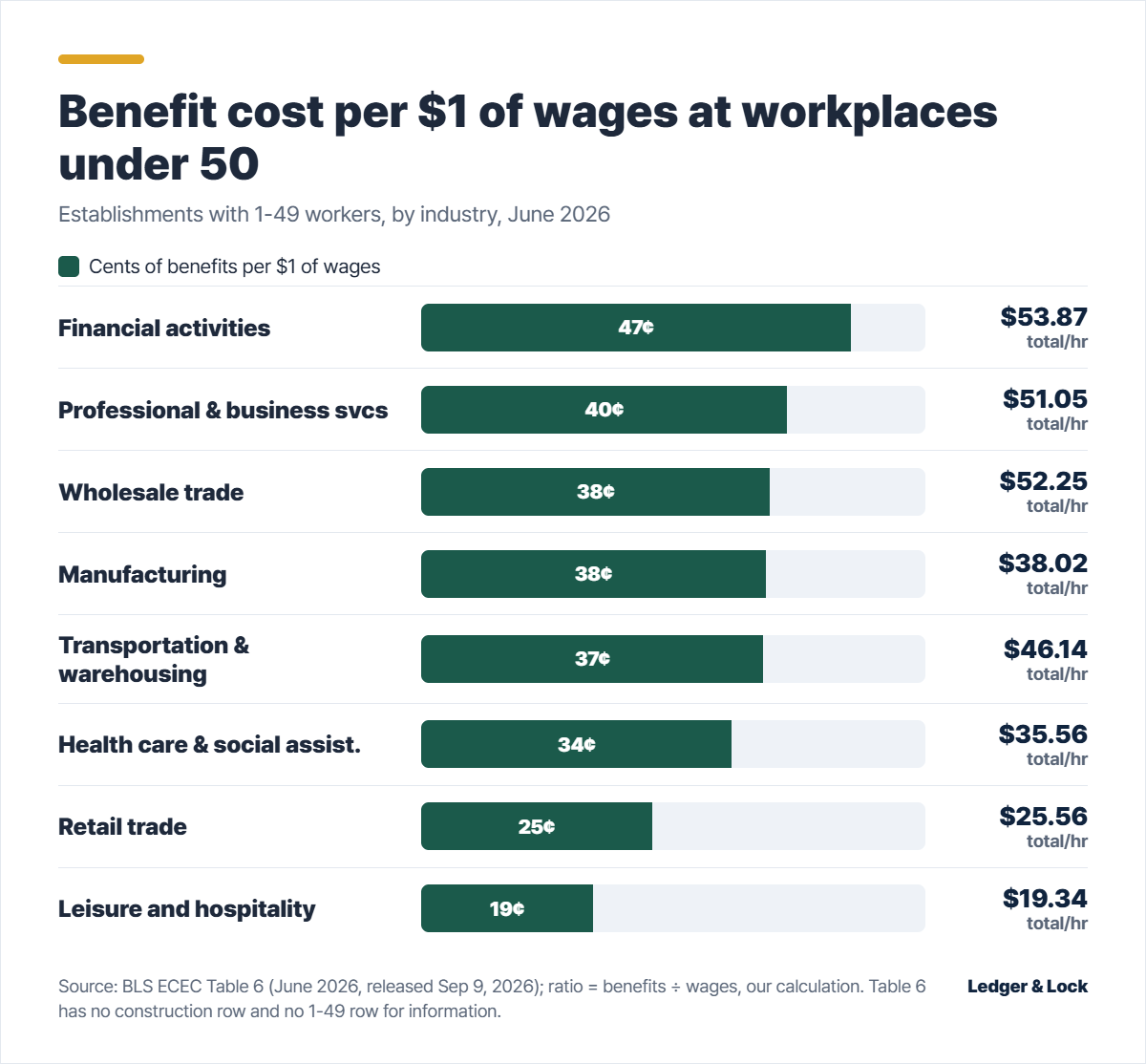
Within the under-50 group, the spread is wide. Financial activities paid 47 cents of benefits per wage dollar and professional and business services 40 cents, while retail trade paid 25 cents and leisure and hospitality 19 cents. Lower ratios in restaurants and stores mostly reflect part-time schedules and fewer workers enrolled in health or retirement plans, since BLS includes every worker in the averages, including those with no plan at all.
| Industry (1-49 workers) | Wages | Benefits | Legally required | Total per hour | Benefits per $1 of wages |
|---|---|---|---|---|---|
| Financial activities | $36.69 | $17.18 | $3.57 | $53.87 | 47¢ |
| Professional and business services | $36.49 | $14.56 | $3.71 | $51.05 | 40¢ |
| Wholesale trade | $37.85 | $14.40 | $3.80 | $52.25 | 38¢ |
| Manufacturing | $27.64 | $10.38 | $3.10 | $38.02 | 38¢ |
| Transportation and warehousing | $33.60 | $12.54 | $3.83 | $46.14 | 37¢ |
| Health care and social assistance | $26.56 | $9.00 | $2.76 | $35.56 | 34¢ |
| Retail trade | $20.42 | $5.14 | $2.20 | $25.56 | 25¢ |
| Leisure and hospitality | $16.29 | $3.05 | $1.81 | $19.34 | 19¢ |
Legally required costs barely move across industries once you scale them to pay: between 9.7% of wages (financial activities) and 11.4% (transportation and warehousing). The optional benefits (insurance, paid leave, retirement, bonuses) are where industries split apart, which is also where an owner has room to decide.
A worked example: pricing a $20 hire at a 9-person gift shop
Hypothetical case: a 9-person gift shop plans to hire a sales associate at $20.00 an hour for 30 hours a week, all year. That is 1,560 paid hours and $31,200 in wages.
The floor the law sets
Employer Social Security and Medicare at 7.65% come to $1.53 an hour, or $2,386.80 a year. Federal unemployment tax at 0.6% on the first $7,000 adds $42, about 3 cents an hour across 1,560 hours. State unemployment and workers’ compensation come from the shop’s own rate notice and insurance quote. For a benchmark, retail workplaces under 50 paid legally required benefits equal to 10.8% of wages in June 2026, which would be $2.15 an hour here. Subtracting the federal pieces leaves about 60 cents an hour that, on average, went to state unemployment and workers’ compensation.
The industry benchmark
Retail sites under 50 paid 25.2 cents of benefits per wage dollar. Applied to $20.00, that is $5.03 of benefits and $25.03 of total cost per hour worked, or about $39,050 a year on 1,560 hours. If the shop pays more benefits than a typical small retailer, say one paid week of 30 hours at $20.00 ($600), that week is paid but not worked, so the cost of every hour actually worked rises by roughly 39 cents.
The same hire in a professional office
Run the same logic for a 9-person bookkeeping or design firm hiring at $30.00 an hour. Professional and business services sites under 50 paid 39.9 cents per wage dollar, so the benchmark total is about $41.97 per hour worked. Before comparing that with a contractor’s rate, read our guide to contractor vs employee mistakes, because the IRS decides classification by the working relationship, not by which option is cheaper.
How we got these numbers, and what they can’t tell you
On November 25, 2026 we saved Table 6 from the June 2026 ECEC release and Table 6 from the June 2025 release as HTML, parsed every row (95 rows in each), and calculated benefits divided by wages, legally required costs as a share of benefits and of wages, and the change between the two Junes. We did not adjust anything for inflation or region, and we used no figures from outside these two tables except the IRS tax rates cited above.
The survey behind the table is large but not a census. The June 2026 sample covered about 6,600 private establishments and 28,300 job observations. BLS reports a relative standard error of 1.8% for the $37.64 total at 1-49 workers (ECEC relative standard errors), so the true figure could plausibly sit about 70 cents higher or lower. Some industry cells are much looser; BLS flags several small-workplace estimates, such as supplemental pay in health care, with errors of 30% or more.
Three more limits matter for an owner. Size is measured per location, so a single store of a large chain counts as a 1-49 site. The averages blend full-time and part-time workers and include people who get no benefits at all, so they describe a typical hour, not a typical full-time job. And the data leave out one-time hiring costs such as recruiting, training time and equipment. One change is coming: from the December 2026 data, published March 11, 2027, BLS will remove workers’ compensation costs from the ECEC, which will make legally required benefits look smaller than in the numbers above.
Questions owners ask about the cost of an employee
Do part-time employees cost less beyond their wages?
Usually yes, per hour. In June 2026, BLS measured $5.05 of benefits on $20.15 of wages for part-time private workers (about 25 cents per wage dollar), against $17.03 on $36.97 for full-time workers (46 cents). Payroll taxes still apply in full; the gap comes from paid leave, insurance and retirement (ECEC Table 5).
Does an employer pay FUTA on every dollar an employee earns?
No. FUTA applies only to the first $7,000 of each employee’s wages each year. At the usual 0.6% rate after the state credit, that is $42 per employee per year. Employers in a credit reduction state pay more on the same $7,000, and the rate details are in IRS Topic 759.
Is hiring a 1099 contractor cheaper than an employee?
It can look cheaper because you do not pay the 7.65% employer Social Security and Medicare share, unemployment tax or benefits for a true contractor. The catch is classification: the IRS looks at behavioral control, financial control and the relationship, and back taxes plus penalties apply if a worker was really an employee.
How often does BLS update employer cost per hour figures?
Every quarter. The June 2026 figures came out on September 9, 2026; the September 2026 figures are scheduled for December 16, 2026, and the December 2026 figures for March 11, 2027, according to the BLS release schedule. Each release keeps the same Table 6 layout by establishment size.
Next step: pull your state unemployment rate notice and your workers’ compensation quote, add them to the 7.65% employer FICA, and compare the result with the 10.7% small-workplace benchmark before you set the pay rate for your next hire. If you are pricing next year’s payroll while closing this year’s books, the small business year end checklist puts that step in order with the bonus and W-2 deadlines. The next ECEC release (September 2026 data) is scheduled for December 16, 2026.
This article is general information drawn from published BLS and IRS data, not tax, legal or payroll advice for your business. For your rates and filing duties, check IRS Publication 15 and your state workforce agency, or ask a payroll professional.
Leave a Reply