
An accountable plan for an S corp home office lets the company repay you for the business share of rent and utilities tax-free, but only if each cost is documented, usually within 60 days.
Passing the home office test is only the first gate. Paperwork timing, a flat monthly allowance, or a reimbursement that lands in payroll as wages can each undo it. December is when those habits show up, because it is the last chance to put 2026 reimbursements on the corporate books.
Why it matters more now: IRS Notice 2026-10 states that section 70110 of the One Big Beautiful Bill Act made permanent the disallowance of miscellaneous itemized deductions, including unreimbursed employee expenses. As an officer who works in the business, you are an employee of your S corp (the IRS page on S corporation officers says those payments are wages). So a home office cost the company never reimburses has no federal deduction waiting for it on your personal return.
Rules below come from IRS Publication 15 (2026), Publication 463, Treasury Regulation 1.62-2 and the IRS mileage rate table, all read on November 20, 2026.
How an accountable plan for an S corp home office works
Publication 15 lists three rules. Your employee (here, you) must have paid the expense while working for the company, must substantiate it within a reasonable period, and must return any excess within a reasonable period. Payments that meet all three “aren’t wages and aren’t subject to income, social security, Medicare, and FUTA taxes.” Regulation 1.62-2(c)(4) adds that they stay off the Form W-2 entirely.
The home office piece has one more gate. Under 26 U.S.C. 280A(c)(1), the space must be used exclusively and on a regular basis as your principal place of business or to meet clients, and “in the case of an employee” that use must be for the convenience of the employer. A spare room that doubles as a guest room on weekends fails the exclusive-use test before the plan even comes into play.
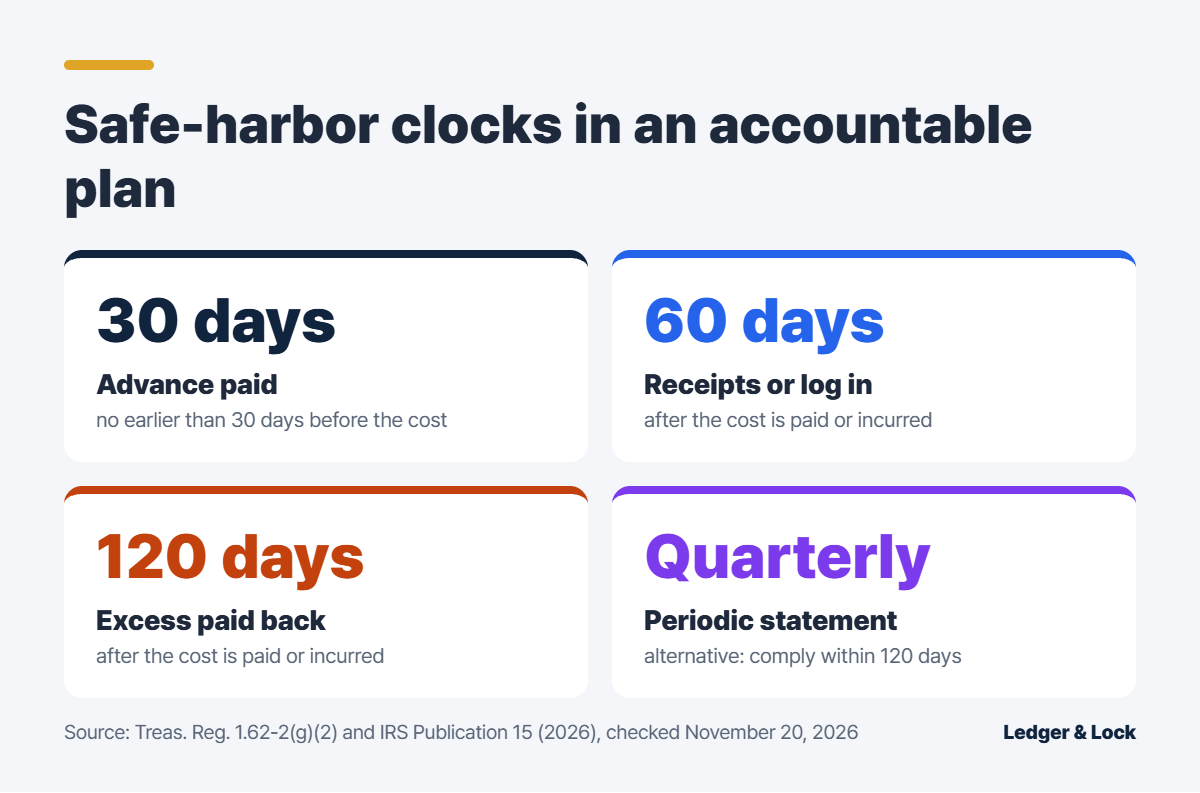
“Reasonable period” depends on facts and circumstances, but the regulation gives a safe harbor. An advance paid within 30 days of the cost, substantiation within 60 days after it, and any excess returned within 120 days all count as reasonable. A quarterly statement asking you to account for or return open amounts, followed by compliance within 120 days, is the other accepted route.
Mistakes that turn the reimbursement into wages, and the fix for each
Each mistake below comes straight from the rules quoted above. None of them needs an audit to go wrong; they go wrong at the moment the money moves.
Paying yourself a flat monthly “home office allowance”
Picture a round $500 a month with no bills attached. Publication 15 says payments are treated as made under a nonaccountable plan when the employee “isn’t required to or doesn’t substantiate timely” the expenses, and nonaccountable payments are wages, treated as supplemental wages. On $6,000 a year that means $459 of employee social security and Medicare tax plus $459 from the company (7.65% each at the 2026 rates of 6.2% and 1.45%), before income tax withholding.
Fix: replace the allowance with a reimbursement figured from the actual bills and the measured office share, paid against a short expense report.
Sending one report for the whole year in December
Rent paid on January 1 and reported on December 15 is well past the 60-day mark in the fixed-date safe harbor. The regulation still allows a facts-and-circumstances argument, but you would be outside the period the IRS has already agreed is reasonable.
Fix: from now on, submit a monthly report in the first week of the next month. For older months, let your CPA decide what can still be reimbursed, and do not backdate the reports.
Running the reimbursement through payroll as pay
Some payroll setups add the amount to gross pay because it is the easiest field to find. Publication 15 says that “if a single payment includes both wages and an expense reimbursement, you must specify the amount of the reimbursement.” Publication 463 also warns that an arrangement repaying business expenses by reducing reported wages is treated as nonaccountable.
Fix: pay it as a separate transfer from the business account, or use a nontaxable reimbursement line in your payroll software, never a wage line.
Reimbursing the personal share of the bill
If the office is 12% of the home, 12% of rent and utilities is the business share. Reimbursing half the internet bill because “you work a lot” needs a documented basis, and commuting miles are personal. Publication 463 lists reimbursement of nondeductible expenses among the payments treated as nonaccountable.
Fix: write the square footage and the method on the first report (for example 150 of 1,250 square feet), and keep a mileage log with date, miles, place and purpose.
Keeping an advance you did not spend
Advances are fine when the excess goes back. Publication 15 says the unreturned excess becomes taxable wages “for the first payroll period following the end of the reasonable period of time.”
Fix: repay the difference within 120 days, or simply stop taking advances and reimburse after the fact.
“Amounts paid under an accountable plan aren’t wages and aren’t subject to income, social security, Medicare, and FUTA taxes.” IRS Publication 15 (2026)
One owner’s December reimbursement, worked through
Hypothetical: Dana is the only employee of a one-person design S corp and works from a 150-square-foot room in a 1,250-square-foot rented apartment, so the business share is 12%. Monthly costs: $2,100 rent, $140 electric and gas, $25 renters insurance. That is $2,265 a month, and 12% of it is $271.80. Dana also counts half of an $80 internet bill ($40) and drives to client sites.
Dana sends one report on December 15, 2026, covering the whole year. The table splits it by whether each item is still inside the 60-day safe harbor on that date. November and December rent qualify; October rent, paid on October 1, crossed 60 days on November 30. Mileage uses the IRS business rate: 72.5 cents for January 1 to June 30, 2026, and 76 cents from July 1 to December 31.
| Item | Inside the 60-day window on December 15 | Outside it (January to October) |
|---|---|---|
| Home office share ($271.80 a month) | 2 months: $543.60 | 10 months: $2,718.00 |
| Internet, 50% of $80 | 2 months: $80.00 | 10 months: $400.00 |
| Mileage | 180 miles x $0.76 = $136.80 | 900 miles x $0.725 = $652.50; 600 miles x $0.76 = $456.00 |
| Total | $760.40 | $4,226.50 |
Only $760.40 of Dana’s $4,986.90 is clearly inside the safe harbor. The other $4,226.50 is not automatically taxable, but it now depends on a facts-and-circumstances judgment instead of a rule the regulation already accepts. Had Dana filed a short report each month, every dollar would sit in the left column.
The same arithmetic also shows the cost of skipping the plan. If Dana paid a flat $500 a month instead, all $6,000 would be wages, carrying the $918 of combined social security and Medicare tax shown earlier, and nothing would be left to deduct personally under Notice 2026-10.
If you already track receipts in an app, the receipt app guide and what the IRS expects from a record covers which fields matter. The same year-end payroll run is where S corp shareholder health insurance gets added to the W-2, so it helps to settle both before the last payroll of December.
What S corp owners ask about home office reimbursements
Do accountable plan reimbursements go on the W-2?
No. Treasury Regulation 1.62-2(c)(4) says amounts paid under an accountable plan are excluded from the employee’s gross income, are not reported as wages on Form W-2, and are exempt from FICA, FUTA and income tax withholding. Only the unsubstantiated or unreturned excess becomes wages.
Is a non accountable plan reimbursement taxable?
Yes. IRS Publication 15 (2026) says payments under a nonaccountable plan are wages, treated as supplemental wages, and subject to income tax withholding, social security, Medicare and FUTA taxes. They are reported on the employee’s Form W-2 like any other pay.
What mileage rate can an accountable plan use in 2026?
The IRS business standard mileage rate is 72.5 cents per mile for driving from January 1 to June 30, 2026, and 76 cents per mile from July 1 to December 31, 2026, per the IRS standard mileage rates table. Split a year-end mileage report at June 30 so each trip uses its own period’s rate.
Can an S corp owner deduct home office costs on their own return instead?
Generally no. IRS Notice 2026-10 says the One Big Beautiful Bill Act made permanent the disallowance of miscellaneous itemized deductions, including unreimbursed employee expenses. An owner who works in the S corp is its employee, so reimbursement through the company is the remaining route for these costs.
When the numbers call for a CPA
This guide does not cover owners who own the home (mortgage interest, property tax and depreciation on a reimbursed office raise questions about basis and later sale), state income tax rules, or reimbursements to other employees with different expense types. If you own the home, or if most of your 2026 costs sit in the right-hand column of the table above, those are the cases to hand to a CPA before the last payroll of the year.
Everyone else can start this week: measure the office, pull the November rent and utility bills, and send your company a one-page report dated today. The small business year end checklist shows where that report fits among the other December closing steps.
This article is general information about federal rules, not tax or legal advice for your business. For your own facts, check IRS Publication 463 and Publication 15 or talk to a CPA or enrolled agent.
Leave a Reply