
A gift card program for small business costs nothing to switch on in Square or Shopify; the price is a per-card fee, about $1.25 to $3.00 on a $50 card at November 2026 list rates.
Small Business Saturday falls on November 28, 2026, two days after Thanksgiving, and digital cards can be selling the same evening you turn them on. Every rate below was read on the vendors’ own pricing and help pages on November 24, 2026 (Eastern time). Where Clover or Toast don’t publish a gift card fee, this guide says so rather than filling the gap with a guess.
What a gift card program for small business costs per card
Square charges in two places when a card is sold and nothing when it is spent. The Square Gift Cards page lists a load fee of 2.5% of the amount added on top of the normal processing fee, and it says there are no additional fees when a customer redeems a card. eGift Cards are free to set up. On the Square pricing page, the load fee is 2.5% on Square Free and Square Plus and 0% on Square Premium, which costs $149 a month per location. Card-present processing runs 2.6% + 15¢ on Free, 2.5% + 15¢ on Plus and 2.4% + 15¢ on Premium.
Two details change the math. A card bought on a Square eGift ordering page is processed at 2.9% + 30¢ according to the gift card page, while the general pricing page lists 3.3% + 30¢ for online payments on Square Free; this guide uses the gift card page’s figure for eGift orders, so confirm it on your own fee report after the first sale. A card paid for in cash has no processing fee, yet the 2.5% load fee still applies because it is charged on the funds added.
Shopify includes gift cards on every plan, per its gift card requirements page. The US Basic plan is $39 a month billed monthly or $29 a month billed yearly on shopify.com/pricing, with online card rates from 2.9% + 30¢ through Shopify Payments. Shopify has no load fee. The catch sits in its third-party transaction fee rules: stores created on or after May 12, 2025 pay that fee on the part of an order paid with a gift card, even when the store uses Shopify Payments. On Basic the rate is 2%; Grow is 1% and Advanced 0.6%. Shopify POS orders are exempt.
Clover’s retail pricing page shows “Clover gift cards (physical or digital)” as Not Included on the Basic system ($349 or $16 a month for 36 months, Starter plan) and included on Standard ($1,899 plus $84.95 a month, or $180 a month for 36 months) and Advanced. Clover’s pricing and gift card pages don’t list a load fee. Toast’s Toast vs. Clover comparison page, last updated November 20, 2026, describes Clover’s charge as $.05 for every $2 loaded (2.5%) and says Toast Gift Cards, sold as an add-on, carry zero load fees. Both claims come from a competitor’s page and the Toast add-on price is quote-based, so ask each vendor for the gift card fee in writing before you order cards. Restaurants comparing full systems can start with our Square vs Toast vs Clover cost breakdown for a coffee shop.
Three December volumes for one hypothetical gift shop
Juniper & Twine is a made-up gift shop with one location. Its cards average $50, and the owner wants to know what the season costs at 20, 100 or 400 cards. Every figure is rounded to the cent and uses the rates above.
20 cards, $1,000 of gift card sales
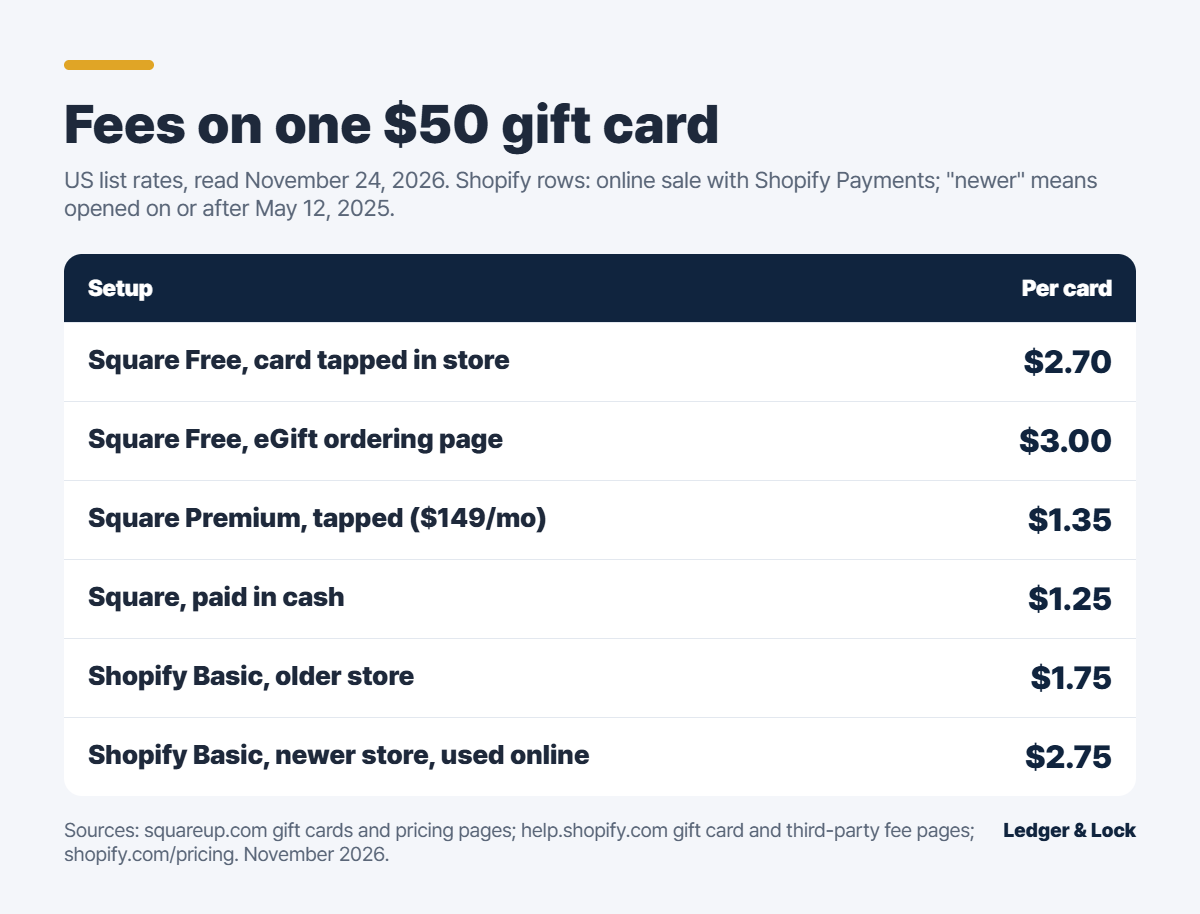
On Square Free with every card tapped at the counter, each card costs $1.25 in load fee (2.5% of $50) plus $1.45 in processing ($1.30 + 15¢), so $2.70 a card and $54 in total. Sold through the eGift ordering page instead, the processing side becomes $1.75 and the total reaches $60. Square Premium would cut card fees to $27, but its $149 monthly fee makes the month $176. At this size, upgrading for gift cards alone makes no sense.
100 cards, $5,000
Square Free in store comes to $270, or 5.4% of the money collected. Shopify Basic sold online lands at $175 for a store opened before May 12, 2025. A newer store pays the same $175 at sale plus $100 later, when the cards are spent online, for $275. That second charge arrives in January or whenever customers shop, so it does not show up on the December fee report. Square Premium is $135 in card fees plus $149, so $284, and still loses to Free by $14.
400 cards, $20,000
Here the Premium question gets real. Square Free in store costs $1,080; Premium costs $540 plus $149, or $689. Counting gift cards only, Premium saves $1.35 per $50 card, so it pays for itself after about 111 cards in a month (149 ÷ 1.35 = 110.4). Premium also lowers the rate on every other card sale, so a shop near that line should run its whole December volume, not gift cards alone. Square Plus at $49 a month saves just 5¢ on a $50 card, which needs 980 cards to break even.
Plug in your own expected count and card amount below. The calculator repeats the steps above so you can check each line.
Gift card fee calculator
Enter how many cards you expect to sell, the average amount on each, and how they will be sold. The math uses the US list rates published by Square and Shopify on November 24, 2026.
Basis: Square gift cards page and Square pricing page (2.5% load fee on Square Free and Plus, 0% on Premium; in-person card rate 2.6% + 15¢ Free, 2.5% + 15¢ Plus, 2.4% + 15¢ Premium; 2.9% + 30¢ on a Square eGift ordering page; plan fees $49 and $149 a month per location). Shopify pricing page and Help Center (Basic online card rate from 2.9% + 30¢ with Shopify Payments; stores created on or after May 12, 2025 pay the plan’s third-party transaction fee, 2% on Basic, on the gift card part of online orders; Shopify POS orders are exempt). All read November 24, 2026. Rounded to the cent. Not covered: monthly plan fees you already pay for other sales, international or premium card rates, physical card printing, sales tax, chargebacks. Estimate only; rates change.
Costs that sit outside the fee table
Physical cards are a separate purchase. Square sends US orders to a partner print site, and its FAQ says the price of physical cards varies by how many you order; we could not confirm a fixed per-card US price on November 24, 2026, so price your order on the order page before you commit. eGift cards skip printing entirely, which matters when Small Business Saturday is only days off.
Bookkeeping changes too. Money from a gift card sale is owed to the cardholder until the card is spent, so most accounting setups book it as a liability (often called unearned revenue) and move it to sales on redemption. Ask whoever keeps your books which account your POS export maps it to before the first big week, not after.
Online gift card pages also attract fraud. Bots use small purchases to test stolen card numbers, and a public eGift page that accepts low amounts gives them an easy place to try. Our guide on how to prevent card testing on your website covers the settings to turn on first. For the in-person side at markets and pop-ups, the hardware notes in card readers for craft fairs still apply, since a gift card sold at a booth runs through the same reader.
Federal gift card rules your cards have to follow
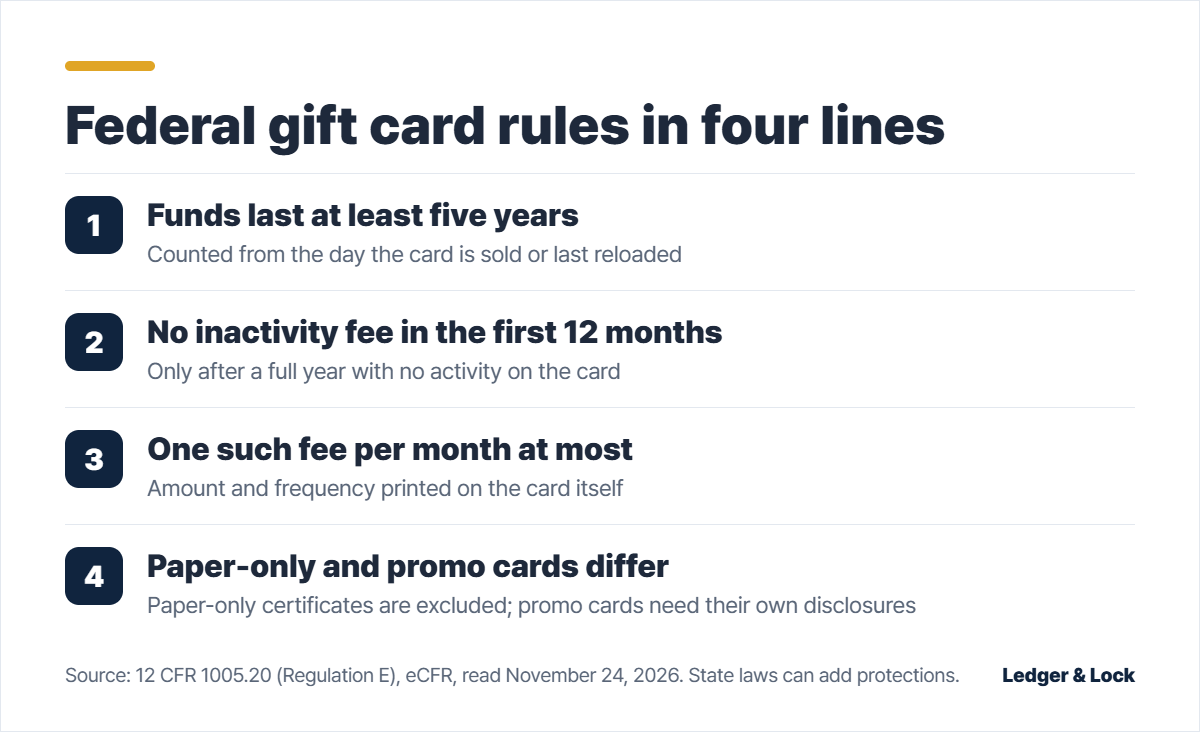
The Credit CARD Act rules for store gift cards live in 12 CFR 1005.20, part of Regulation E. Three of them shape how you set up a program. Funds cannot expire sooner than five years after the card was issued or last loaded. A dormancy, inactivity or service fee is allowed only after a full year with no activity, only when the amount and frequency are printed on the card, and no more than once in a calendar month. Fees that may apply must be disclosed to the buyer before purchase and cannot be changed afterward.
Federal rules set a floor: card funds good for at least five years, and no inactivity fee in the first year. Your state may add more. (12 CFR 1005.20; CFPB)
Some cards fall outside those definitions. Gift certificates issued in paper form only are excluded, and so are loyalty, award or promotional cards, although promotional cards must carry their own disclosures, such as a statement on the front that the card is promotional and the date its funds expire. A free $10 card handed out with a $50 purchase is a promotional card; a $50 card a customer pays for is a store gift card. Square’s FAQ says its own gift cards do not expire.
State law can go further. The CFPB notes that some state laws give cardholders more time than the federal five years, and the FDIC says some states add separate protections. Unclaimed property rules for old balances also differ by state, so check your state treasurer or unclaimed property office before deciding what happens to balances that sit untouched for years.
For the rest of the tool stack and what each piece costs a month, see the small business software cost guide.
What owners ask before selling gift cards
Do small businesses pay a fee when a gift card is redeemed?
On Square, no. Square’s gift card page says there are no additional fees when a customer redeems a card, because the 2.5% load fee and processing were charged at sale. Shopify is different for stores created on or after May 12, 2025: online orders paid with a gift card carry the third-party transaction fee, 2% on Basic.
Can a small business put an expiration date on gift cards?
Yes, within limits. Under 12 CFR 1005.20 the funds must stay usable for at least five years from the date the card was issued or last loaded, and the expiration date has to be disclosed on the card. Some states require more time, so check your state’s gift card law before printing a date.
How do I make gift cards for my small business?
Start with the gift card feature in the system you already take payments on. Square eGift Cards are free to set up from the Square Dashboard, and Shopify lists gift cards under Products, then Gift cards, on every plan. Physical cards are ordered from each vendor’s print partner or hardware store, with prices by quantity.
Is gift card software free for small business?
Setup often is; selling is not. Square eGift Cards cost $0 to set up but charge a 2.5% load fee plus processing on each sale. Shopify includes gift cards on plans from $29 a month billed yearly. Clover’s retail pricing page includes gift cards only on its Standard and Advanced systems, not Basic.
Before the first card sells this week, open the gift card settings in the system you already use, read the terms text a buyer will see, and make sure it states that the funds don’t expire or gives a date at least five years out.
Rates and plan prices from Square, Shopify, Clover and Toast public pages and the eCFR, read November 24, 2026 (Eastern time). Vendors change prices; recheck the linked pages before you decide.
This article is general information about software pricing and federal rules, not legal, tax or accounting advice. For your state’s gift card and unclaimed property rules, check your state attorney general or treasurer, and see the federal rule text for the full requirements.
Leave a Reply