
A card reader for craft fairs has one job the store counter never tests: keep taking chip cards when the hall’s signal drops. Square, SumUp and Shopify POS charge nearly the same per sale, so offline rules and upfront costs decide it.
The timing matters this year. Square’s help center says offline payments were set to switch on automatically for every device in April 2026 unless the seller opted out, while Shopify still makes you turn the feature on and set your own limits. SumUp’s Solo reader takes yet another route and carries its own 4G connection. Those are three different answers to a gym with one bar of service, and they matter more than a nickel of fee difference.
Prices and rules below come from each company’s US pricing, hardware and help pages, read on November 22, 2026 (ET). Sale prices that were running that day are noted but not used in the math.
What a craft fair booth asks of a card reader
A booth differs from a shop in a few predictable ways. Lines form in bursts when a session lets out, tickets are small, Wi-Fi is often a shared password taped to a pillar, and you may sell only six weekends a year. Weigh each option against these points before looking at brand names:
- Offline behavior. How long the reader keeps accepting cards without a connection, and how long you have to upload those sales before they expire.
- The fixed cents per sale. On an $8 ornament, the 10¢ or 15¢ part of the fee is a bigger share than the percentage.
- Upfront hardware. A $49 to $99 reader is a real cost when the whole season grosses a few thousand dollars.
- A monthly plan. Some setups add nothing per month; Shopify POS rides on a store subscription.
- Payout speed. Booth fees, materials and the next fair’s deposit often come due before the season ends.
Two questions sit outside this guide: whether your state or county wants a sales tax permit for temporary events, and whether the fair organizer requires a specific payment system. Ask the organizer and your state revenue department about both.
Square vs SumUp vs Shopify POS, published numbers side by side
Here is what each company lists for a US seller taking cards in person on its entry plan. Every figure links back to the page it came from.
| Item | Square (Free plan) | SumUp (Standard, $0) | Shopify POS (Basic) |
|---|---|---|---|
| Monthly cost | $0 | $0 | $39 billed monthly |
| Tap, chip or swipe | 2.6% + 15¢ | 2.6% + 10¢ | 2.6% + 10¢ |
| Keyed-in card at the booth | 3.5% + 15¢ | 3.5% + 15¢ | 3.5% + 10¢ |
| Phone-linked reader (list price) | $59 Reader for contactless and chip | $54 SumUp Plus ($37 on sale November 22) | $49 Tap & Chip without dock ($89 with dock) |
| Standalone reader with its own data | Square Terminal (not priced here) | $99 SumUp Solo (shown sold out November 22) | None in this price range |
| Offline card sales | On by default since April 2026 unless you opted out; 24 hours on the Reader, 72 hours to upload | Listed on the Solo page; limits not documented for the US | Opt-in; you set daily and per-order caps |
| Payout timing | Next-day transfers included | Next-day payouts on every plan | 3 business days minimum settlement in the US |
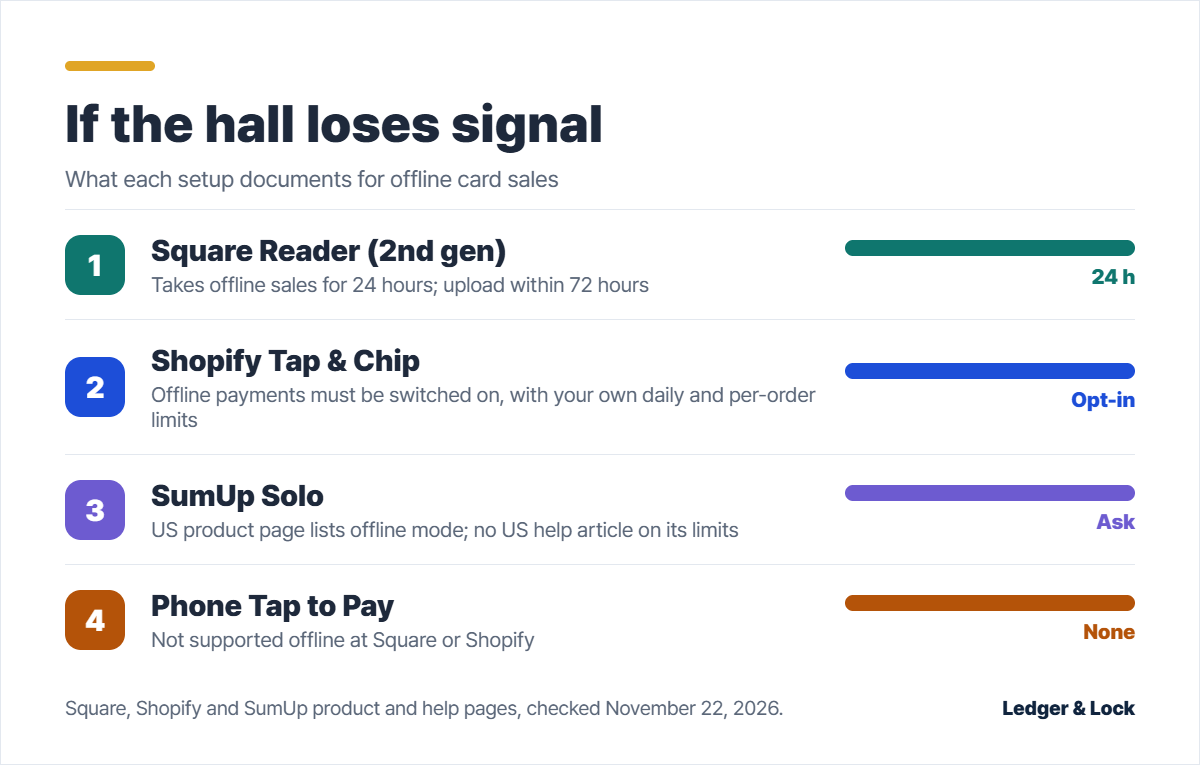
Offline is where the three part ways. Square’s offline FAQ gives the 2nd-generation Reader a 24-hour window to accept offline payments, and any pending sale that is not uploaded within 72 hours expires and cannot be recovered. Shopify’s offline payments page requires POS app version 9.14.0 or later, a compatible reader such as the Tap & Chip, a staff permission, and two numbers you choose: a device daily limit and a per-transaction limit. SumUp’s Solo page promises “offline mode as a backup if your signal drops,” yet no US help article explaining its time limits turned up on November 22, so ask SumUp support before you rely on it.
Phone-only checkout has a catch here too. Both Square and Shopify list Tap to Pay on iPhone and Android, along with manually entered cards, among the payment types that do not work offline. A booth that plans to skip the reader and take taps on a phone needs a signal for every sale.
What a card reader for craft fairs costs over three December weekends
Take a hypothetical candle maker working three holiday fairs in December. She expects 240 card sales averaging $28, or $6,720 tapped or dipped, and needs one reader. Her costs at published rates, list prices and one month of plan fees come out like this:
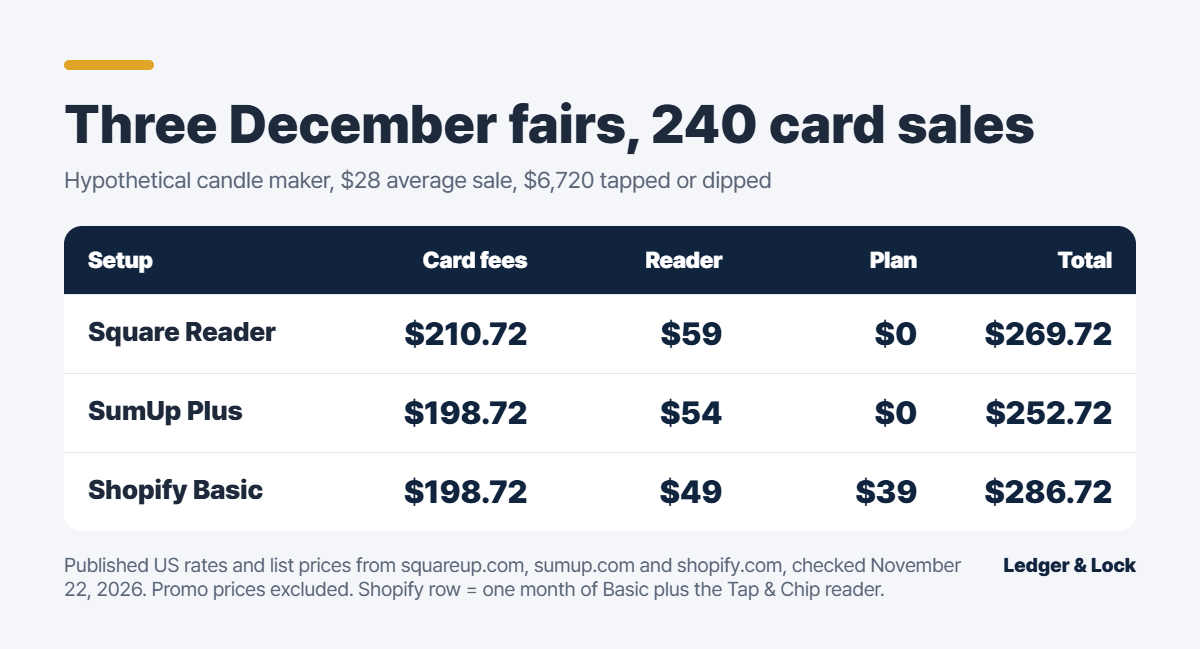
The percentage part is identical everywhere: 2.6% of $6,720 is $174.72. The difference is the fixed fee. At 15¢, Square adds $36 across 240 sales; at 10¢, SumUp and Shopify add $24. That $12 gap is smaller than the spread in reader prices, which runs from $49 to $59, and far smaller than one month of Shopify Basic at $39.
For a seasonal booth, the per-sale fee gap between these three is a few cents. Reader price, any monthly plan and what happens to sales taken offline move the total far more.
Small tickets shift the picture a little. An $8 ornament costs 36¢ to process on Square (about 4.5% of the sale) and 31¢ on SumUp or Shopify (about 3.9%). A booth that sells mostly stocking stuffers under $10 feels that nickel more than our candle maker does. Keyed-in sales cost more on all three, so a card that will not tap or read its chip is worth a second try before you type the number.
Already paying for Shopify to run an online store? Then the $39 is not new money, and her Shopify total drops to $247.72 for the season, the lowest of the three. The Stripe vs Square vs PayPal fee comparison for online sales covers the web side of that decision.
Which setup fits which booth
A barn, church basement or school gym with weak signal
Here the offline rules count more than any fee. Square’s Reader works offline out of the box for a 24-hour session, which covers a Saturday show, and the app shows a countdown banner while you are offline. A SumUp Solo carries its own 4G and Wi-Fi, which helps where the venue Wi-Fi is the weak link, though its offline limits are not documented for the US. Whichever you pick, expect declines to surface only after you reconnect; Square says you carry the loss on expired, declined or disputed offline payments.
You already sell online with Shopify
Shopify POS earns its keep when your booth and website share stock. Shopify sells POS as one system with your online store, so the booth and the website work from the same product list, and the in-person rate on Basic matches SumUp at 2.6% + 10¢. The Tap & Chip reader needs a US location selling in USD, and payouts settle in no less than 3 business days, so plan cash for booth fees accordingly.
Most items sell for under $10
On small tickets the 10¢ fixed fee at SumUp and Shopify saves about a nickel a sale against Square. Across 400 ornament sales that is $20, roughly the price difference between two readers. Count your average ticket from last year’s notes before treating it as the deciding factor.
Two people working one table
A second reader on Square costs another $59 at list, a second SumUp Plus $54 and a second Tap & Chip $49. Neither Square’s Free plan nor SumUp’s $0 plan lists a monthly charge for a second reader, while Square Plus at $49 a month per location and SumUp POS Plus at $49 a month exist for sellers who need more staff tools. For a December-only booth, a second reader usually costs less than a plan upgrade. The Square vs Toast vs Clover guide for a small coffee shop shows where those paid tiers start to pay off for a year-round counter.
Card reader questions vendors ask before a fair
Does Square Reader work without wifi?
Yes, with offline payments turned on. Square’s offline FAQ gives the Square Reader for contactless and chip (2nd generation) a 24-hour window to take offline sales, and the help page says pending payments expire after 72 hours if not uploaded. Tap to Pay on a phone, manually keyed cards and Square gift cards cannot be taken offline.
Does SumUp Solo work without wifi?
The Solo can skip Wi-Fi because it has its own 4G connection, according to SumUp’s US product page, which also lists an offline mode as a backup when the signal drops. On November 22, 2026, no US help article set out that mode’s time or amount limits, so confirm with SumUp support before a fair with poor coverage.
Is SumUp cheaper than Square?
Per sale, slightly. SumUp’s US pricing page lists 2.6% + 10¢ for in-person payments with no monthly fee, while Square’s Free plan lists 2.6% + 15¢. That is 5¢ per sale, or $12 across 240 sales. At list price, SumUp Plus costs $54 and Square’s contactless and chip reader $59.
Can you use Shopify POS without a card reader?
Yes. Shopify POS supports Tap to Pay on iPhone and on Android, so a phone can take contactless cards and wallets. Shopify’s offline payments page, however, lists Tap to Pay among the methods that are not supported offline, so a phone alone needs a working connection for every card sale at the booth.
The night before your first fair
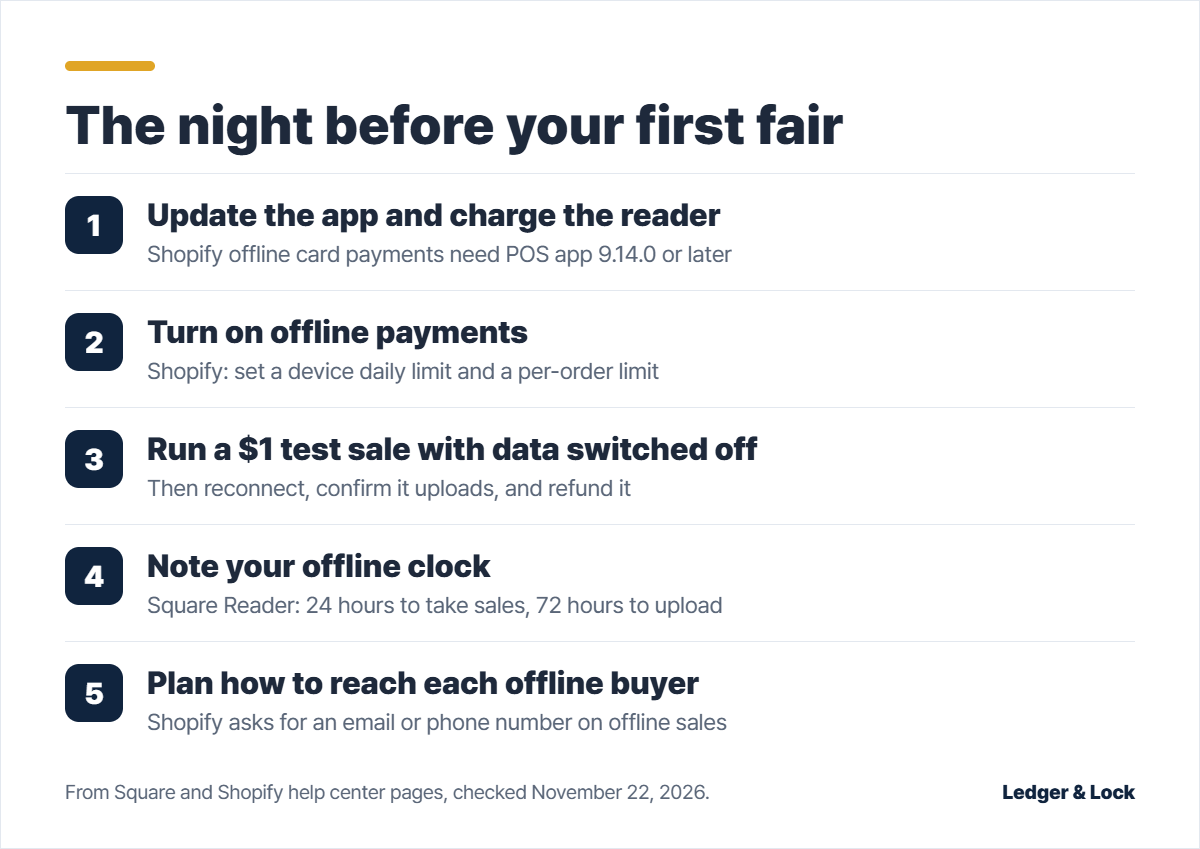
Put the reader through one rehearsal at the kitchen table. Charge it, update the app, switch your phone’s data and Wi-Fi off, and run a $1 sale on your own card. Turn the connection back on, watch the sale upload, then refund it. Refunds wait until an offline payment has uploaded on Square, so this also shows you how long that takes. On Shopify, write the device daily limit you chose on the cash box lid so whoever covers your lunch break knows the ceiling.
A declined offline sale is a lost sale unless you can reach the buyer, which is why Shopify asks for an email or phone number on each one. For disputes that come later, the guide to responding to a chargeback on Stripe, Square or PayPal lays out the evidence to keep, and the small business software cost breakdown, tool by tool shows where a payment app fits next to the rest of your monthly bills.
Sources: Square pricing, Reader product page and offline payments help articles; SumUp US pricing, card reader comparison and Solo pages; Shopify pricing, Tap & Chip hardware page, offline payments and payout timing help articles. All checked November 22, 2026 (ET). The candle maker is hypothetical.
This article is general information, not financial, tax or legal advice. Processor rates, hardware prices and offline rules change; confirm current terms on each company’s own pricing and help pages, and check your state’s rules for selling at temporary events.
Leave a Reply