

What to do after a data breach at a small business: contain it, keep the evidence, find whose data left, then notify on the shortest clock, often 30 days.
The statutes and federal pages linked below were read on Oct. 27, 2026. Breach laws get amended (California changed its deadline in 2025), so open the current text before you rely on a date.
This guide is built as a set of if/then branches. Read the first section now, then jump to whichever situation matches yours. It covers the federal and state notice rules most likely to reach a small U.S. business; it does not replace a lawyer who handles breach notices, and the FTC itself suggests bringing one in.
If you just found it: what to do after a data breach on day one
The FTC’s Data Breach Response: A Guide for Business puts securing your systems ahead of everything else, and one line in that section is easy to get backwards.
“Take all affected equipment offline immediately,” the FTC says, “but don’t turn any machines off until the forensic experts arrive.”
In practice that means unplugging the network cable or turning off Wi-Fi on the affected laptop or server while leaving it powered on. Then change the passwords of every authorized user on the affected systems. The FTC’s reasoning is blunt: if a hacker stole credentials, you stay exposed until those credentials change, even after the hacker’s tools are removed.
Resetting dozens of shared passwords goes faster when they already live in one team vault. The seat-by-seat password manager comparison shows what 1Password, Bitwarden and Keeper charge a small office.
If the attack is ransomware, the copy that gets you running again is the one the attacker could not reach. Our small business data backup plan built on the 3-2-1 rule shows how to keep one copy offline and how to rehearse a restore before you need it.
Three more things belong in the first day. If personal information was posted on your own website by mistake, take it down and ask search engines not to keep cached copies. Interview whoever spotted the problem and write down the date and time they first noticed it, since several deadlines below run from that moment. And keep every log, email, and disk image; the FTC’s list says plainly not to destroy forensic evidence while you fix things.
For outside help, the FTC suggests an independent forensics firm to find the source and scope, plus legal counsel with privacy experience. For law enforcement, it says to call your local police first, and if they don’t handle data compromises, the local FBI field office or the U.S. Secret Service. Online fraud can also be filed with the FBI’s Internet Crime Complaint Center (IC3). If the breach started with a spoofed invoice or a wire that already left, the recovery steps in our guide to stopping business email compromise before you wire money apply the same day.
If the data belongs to another business, tell the owner first
Bookkeepers, payroll services, IT providers, and anyone else who stores records for clients sit in a different spot. You usually don’t notify the clients’ customers yourself; you notify the client, fast. California’s statute (Civil Code 1798.82(b)) says a business that maintains data it does not own must tell the owner “immediately following discovery.” New York’s General Business Law 899-aa uses the same “immediately” and adds a hard limit of 30 days after discovery.
The same logic runs the other way for payment data. If card or bank account numbers were taken but you don’t maintain those accounts, the FTC says to notify the institution that does, so it can watch for fraud. For a shop that takes cards, the first call usually goes to the card processor’s risk or fraud team. If Social Security numbers were stolen, the FTC suggests contacting Equifax, Experian, and TransUnion, and telling them up front if your letters will recommend fraud alerts or freezes. New York makes that contact mandatory once more than 5,000 New York residents are notified at one time.
If customers’ personal information left your control, which state clock applies?
Every state, plus the District of Columbia, Puerto Rico, and the U.S. Virgin Islands, has a breach notification law, according to the FTC. Each one protects its own residents, so a shop in Texas with customers in California and Florida reads three statutes, not one. Export a state count from your billing system or CRM before you read further; it decides which clocks run. Four large states show how much the rules differ.
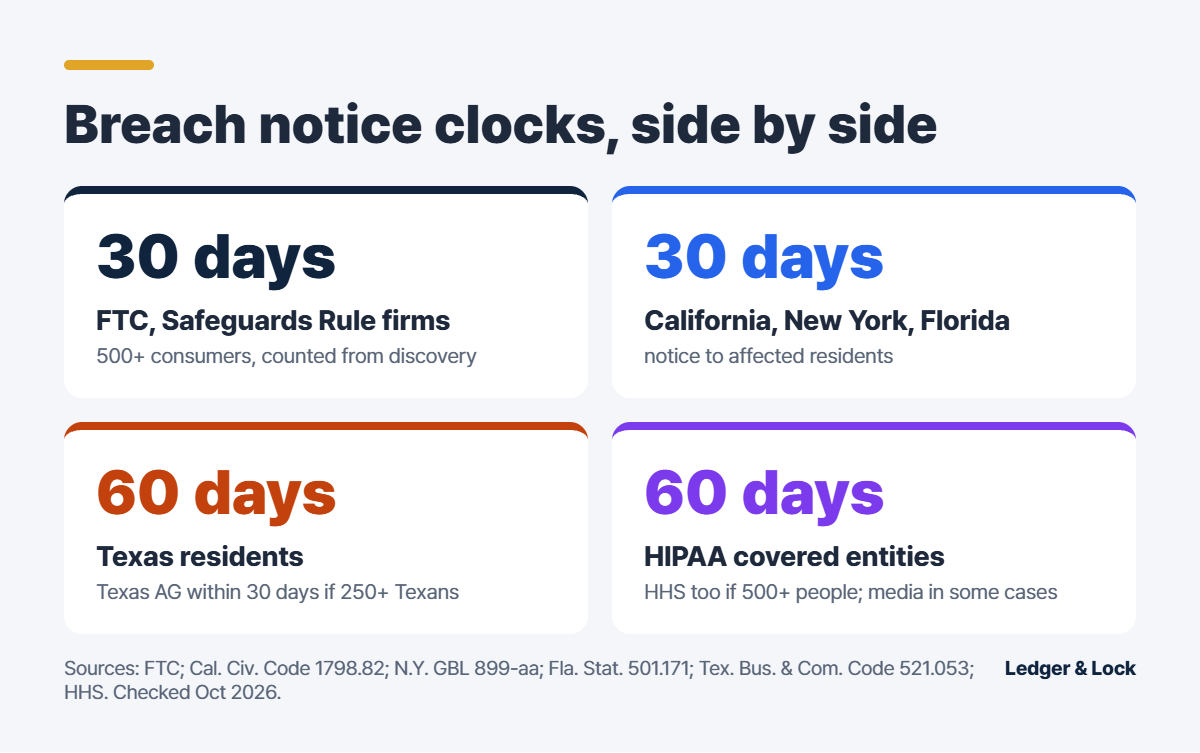
California. Since a 2025 amendment (SB 446), notice to residents is due within 30 calendar days of discovery or notification of the breach, with delays allowed for a law enforcement request or to determine scope and restore the system. The letter must be titled “Notice of Data Breach.” If more than 500 Californians get a letter, a sample copy goes to the Attorney General within 15 calendar days of notifying them.
New York. Notice is due “in the most expedient time possible and without unreasonable delay,” and within 30 days after discovery. Notice also goes to the state Attorney General, the Department of State, and the Division of State Police.
Texas. Under Business and Commerce Code 521.053, residents must be notified no later than the 60th day after you determine the breach occurred. If 250 or more Texans are affected, the Attorney General must hear from you within 30 days, and since Sept. 1, 2023 that report goes through the online Data Breach Report form.
Florida. Section 501.171 gives 30 days after the determination of a breach, or reason to believe one occurred, with 15 more days possible if you give the Department of Legal Affairs a written good-cause reason within those 30 days. A breach touching 500 or more Floridians also requires notice to that department.
If you are a Safeguards Rule business or you hold health records
Tax preparers, mortgage brokers, collection agencies, and other non-bank “financial institutions” under the FTC Safeguards Rule have a federal clock on top of the state ones. Since May 13, 2024, they must notify the FTC as soon as possible, and no later than 30 days after discovery, when unencrypted customer information about at least 500 consumers is acquired without authorization. Unauthorized access is presumed to be acquisition unless you have reliable evidence it wasn’t. The report goes through the FTC’s Safeguards Rule notification form. Not sure the rule covers you? Our breakdown of who the FTC Safeguards Rule applies to walks through the definitions. If you prepare tax returns on your own and still need the written plan itself, the sample WISP for a sole proprietorship tax office includes a one-page breach sheet to print before you need it.
Health data runs on a different calendar. HIPAA covered entities must notify affected individuals without unreasonable delay and no later than 60 days after discovery, according to HHS. A breach affecting 500 or more people also goes to HHS within 60 days, and one affecting more than 500 residents of a state requires notice to prominent media there. Smaller breaches can be logged and reported to HHS within 60 days after the end of the calendar year. Health apps outside HIPAA may fall under the FTC’s Health Breach Notification Rule instead, which the FTC guide flags separately.
A worked deadline calendar for one hypothetical firm
Here is a made-up case to show how the clocks stack. A nine-person bookkeeping and tax-prep office in Austin learns on Monday, Nov. 16, 2026, that a phished login opened its client file share. The exposed files hold names and Social Security numbers for 620 clients, unencrypted: 540 in Texas, 50 in California, and 30 in Florida.
- FTC: a tax-prep firm is a Safeguards Rule financial institution, and 620 is above 500, so the FTC form is due by Wednesday, Dec. 16, 2026.
- Texas Attorney General: 540 Texans is above the 250 threshold, so the online report is also due by Dec. 16, assuming the firm determined the breach on Nov. 16.
- Texas clients: letters are due by Friday, Jan. 15, 2027, the 60th day.
- California clients: 30 calendar days lands on Dec. 16. No Attorney General sample is needed, because 50 is well under 500.
- Florida clients: also Dec. 16, counted from the determination date, and no department notice, since 30 is under 500.
The lesson is in the overlap. Texas allows 60 days for its own residents, but the FTC and two other states set Dec. 16, so a firm that mails everyone at once should plan around Dec. 16 and print letters in early December. The start points also differ: the FTC and California count from discovery, while Texas and Florida count from when you determine a breach happened. Under the Safeguards Rule, discovery is the first day any employee, officer, or agent other than the attacker knew about it, so the note you wrote on day one matters.
Much of this is easier when the basics were in place beforehand, and a small business cyber security checklist in order covers MFA, offline backups and the one-page plan this guide assumes you will write.
When it’s time to write the notice letter
The FTC guide includes a model letter, and its headings line up with the ones California requires: “What Happened?”, “What Information Was Involved?”, “What We Are Doing”, “What You Can Do”, and “For More Information.” Starting from that structure keeps you close to California’s format, though other states can add their own required contents, so have counsel check the final text.
Inside those headings, the FTC recommends saying how the breach happened, what was taken, how it has been misused if you know, and what you are doing about it. When Social Security numbers or financial information were exposed, it suggests offering at least a year of free credit monitoring or identity theft protection. One line is easy to forget: tell people how you will contact them from now on, such as “by mail only, never by phone,” so scammers who copy your letter have a harder time.
Point readers to IdentityTheft.gov/databreach, which the FTC suggests attaching to the letter. As of Oct. 27, 2026, the page opens with “Did someone use your information?”, sends people who answer yes to a report form, and gives everyone else “Step 1: Check, freeze, and monitor your credit” followed by a Step 2 list sorted by what was exposed, from Social Security numbers and account logins to card numbers and children’s information.

If none of this has happened to you yet, set aside an hour this week for a one-page sheet: where customer records live, which states your customers are in, the forensics firm and lawyer you would call, and your processor’s fraud line. While you’re at it, turn on multi-factor authentication for every shared account, since a single stolen password is enough to open a file share like the one in the example above.
This article is general information, not legal advice. Breach notification duties depend on your industry, the data involved, and each affected person’s state; confirm current requirements with the statutes linked above, the FTC’s business guidance at ftc.gov, or an attorney who handles data breach notices.
Leave a Reply