
A good year can leave the January 15 payment smaller than you fear. To calculate safe harbor estimated tax payments, take the smaller of 90% of your 2026 tax or 100% of your 2025 tax (110% if 2025 AGI topped $150,000), then subtract what you have paid.
Whatever is left is the amount that stops the underpayment penalty for the fourth payment period, which runs September 1 through December 31 and is due January 15, 2027, according to IRS Publication 505 (2026). The rest of your real tax bill can wait for the return in April. Below, one hypothetical painting contractor is followed through the math, including the small penalty that earlier short quarters still leave behind and the ways to shrink it before the payment goes out.
Where the safe harbor number comes from
Publication 505 sets the general rule for 2026: you generally owe estimated tax if you expect to owe at least $1,000 after withholding and credits, and your withholding and credits will cover less than the smaller of 90% of the tax on your 2026 return or 100% of the tax on your 2025 return. The 2025 return has to cover all 12 months. The same page applies the 110% figure when your 2025 adjusted gross income was more than $150,000, or more than $75,000 if you file married filing separately for 2026.
The “last year” number is not the balance you paid in April. Publication 505 tells you to start from the total tax on Form 1040, line 24, and then take out a short list of items such as refundable credits. For a sole proprietor that total already includes self-employment tax from Schedule SE, which is why it is usually much larger than the income tax alone.
Two numbers, then, decide the target: your 2025 total tax, which is fixed and sitting on a filed return, and your projected 2026 total tax, which is a guess until your books close. In a year when profit rose, the 2025 figure is almost always the smaller one, and that is what makes the safe harbor useful. It lets you hit a known number without predicting December sales.
How to calculate safe harbor estimated tax payments for one painting contractor
Take a hypothetical owner, Marisol, who runs a three-person house painting company as a single-member LLC taxed as a sole proprietorship and files single. Her 2025 return showed total tax of $18,400 on AGI of $132,000. A repaint contract with an apartment complex lifted her 2026 profit, and her bookkeeper now projects 2026 total tax of about $26,000. She sent $4,000 on April 15, $4,000 on June 15 and $3,000 on September 15, for $11,000 so far, and she has no W-2 withholding.
The two candidates are 90% of $26,000, which is $23,400, and 100% of $18,400, which is $18,400. Her AGI was under $150,000, so the 100% figure applies. The smaller one, $18,400, is her required annual payment. Subtract the $11,000 already paid and the January 15 target is $7,400. The remaining $7,600 of her projected tax is due with the return by April 15, 2027.
If Marisol’s 2025 AGI had been $160,000 instead, the prior-year figure would be 110% of $18,400, or $20,240, and the January payment would rise to $9,240. If her 2026 had gone badly and the projected tax fell to $15,000, 90% of that year ($13,500) would become the smaller number and she would need only $2,500. The calculator below runs the same steps with your numbers.
Enter the figures from your 2025 return and your current projection to see the January 15 amount.
Safe harbor check for the January 15 payment
Works out the smallest total your 2026 withholding and estimated payments need to reach to avoid the underpayment penalty, and what is left to send by January 15, 2027. Individual filers only (sole proprietors, partners, S corporation owners).
Basis: IRS Publication 505 (2026), Chapter 2, and the Instructions for Form 2210: the required annual payment is the smaller of 90% of the 2026 tax or 100% of the 2025 tax (110% when 2025 AGI was over $150,000, or $75,000 married filing separately), and no penalty applies when the 2026 tax minus withholding (not estimated payments) is under $1,000. Checked November 10, 2026. Amounts are rounded to whole dollars. Not covered: farmers and fishers, the annualized income installment method, corporations, state estimated tax, and the penalty for earlier quarters that were short (the IRS figures that per period). Estimate only; Form 2210 is the final word.
How we checked this calculator
We ran these numbers on Nov 25, 2026: four hypothetical filers worked out by hand from the required annual payment rule in the 2026 Form 1040-ES instructions and Publication 505 (2026) (the smaller of 90% of the 2026 tax or 100% of the 2025 tax, 110% when 2025 AGI was over $150,000), then entered into the calculator above. Set 1 is Marisol’s example above.
| Hypothetical inputs | Official-rule result | Calculator result |
|---|---|---|
| Hypothetical 1: 2025 tax $18,400, AGI $150,000 or less; 2026 tax $26,000; paid $11,000 | Target $18,400 (100% of 2025); send $7,400; $7,600 due in April | $18,400; $7,400; $7,600 |
| Hypothetical 2: 2025 tax $40,000, AGI over $150,000; 2026 tax $50,000; paid $30,000 | Target $44,000 (110% of 2025); send $14,000; $6,000 due in April | $44,000; $14,000; $6,000 |
| Hypothetical 3: 2025 tax $30,000; 2026 tax $20,000; paid $12,000 | Target $18,000 (90% of 2026 is smaller); send $6,000 | $18,000; $6,000 |
| Hypothetical 4: 2025 tax $10,000; 2026 tax $15,000; paid $12,000 | Target already met; send $0; $3,000 due in April | $0; $3,000 |
What it does not cover: farmers and fishers, the annualized income installment method, the under-$1,000 test in the Form 2210 instructions, and the penalty for quarters that were already short.
The early quarters still carry a small penalty
Reaching $18,400 by January 15 does not wipe the slate clean for the whole year. The required installment for each of Marisol’s four periods was one-fourth of $18,400, or $4,600, and she sent less than that each time. Publication 505 is direct about how that is treated:
“The penalty is figured separately for each payment period.” IRS Publication 505 (2026), Chapter 2
The Instructions for Form 2210 apply each payment to the oldest shortfall first. Marisol’s April payment left $600 unpaid for 61 days. Her June payment covered that and left $1,200 short until September 15. Her September payment covered the $1,200 and left $2,800 short until the January payment. The penalty rate is the IRS underpayment rate on the quarterly interest rates page: 6% for April through June 2026 and 7% for July through December 2026, with the January 2027 rate not yet announced as of November 10, 2026.
At those rates, and assuming 7% carries into January, the three shortfalls cost about $6, $21 and $66, roughly $92 in total. Marisol can accept that or use one of the routes below to shrink it. Skipping the January payment entirely would leave the fourth period short as well, and the penalty on that shortfall would keep running until she paid, or until April 15, 2027, if that came first.
Ways to close the gap before January 15
A plain January payment is the default, but three other routes appear in the IRS instructions, and one of them can erase the small penalty above.
- Add W-2 withholding in December. The Form 2210 instructions treat federal income tax withheld as paid one-fourth on each due date unless you show otherwise. An S corporation owner who runs payroll for herself, or a spouse with a W-2 job on a joint return, can raise withholding on the last paychecks of the year and have it count back toward April, June and September. If the extra comes through a year-end bonus, the guide to the holiday bonus tax rate explains how flat-rate bonus withholding is figured.
- File early instead of paying in January. Publication 505 says that if you file your 2026 Form 1040 by January 31, 2027, and pay the rest of the tax you owe, you don’t need to make the January 15 payment. Any penalty for the first three periods is still figured, but only up to the filing date. That leaves about four weeks after December 31 to close the books, so it suits owners whose records are simple and whose 1099 forms arrive early.
- Use the annualized income method. If most of your profit came late in the year, as with a holiday retailer, Schedule AI in the Form 2210 instructions can lower the required installments for the early periods, because they are matched to the income you had earned by each date. It means attaching Form 2210 to the return and doing more math, so it is worth it mainly when the early-quarter penalty is large.
Whichever route you take, the January payment amount comes from the same target, so put that number in front of whoever prepares the return before you send money. The year-end tasks around it, from 1099 vendor lists to the payroll filings due February 1, are laid out step by step in the small business year-end checklist.
C corporations pay the last installment on December 15
Everything above applies to people: sole proprietors, partners and S corporation shareholders, who the IRS estimated taxes page says generally pay estimated tax when they expect to owe $1,000 or more. A C corporation runs on a different clock. The Instructions for Form 2220 put its installments on the 15th day of the 4th, 6th, 9th and 12th months of the tax year, so a calendar-year corporation’s last 2026 installment is due Tuesday, December 15, 2026, a month before the individual deadline.
The corporate threshold is $500 of expected tax, per the same IRS page, and the safe harbor has no 90% step. A corporation avoids the penalty by paying the smaller of the tax on its 2026 return or the tax on its 2025 return, as long as the 2025 return covered 12 months and showed some tax. A corporation that had $1 million or more of taxable income in any of the three prior years counts as a large corporation and can use last year’s tax only for its first installment. If your company is a C corporation, put December 15 on the calendar now, because it falls a full month before the individual date.
What the Direct Pay screen asks for
Individual estimated payments can go through IRS Direct Pay, your IRS online account, EFTPS, or a Form 1040-ES voucher by mail, where the postmark date counts as the payment date, per the IRS estimated taxes page. As of November 10, 2026, the first Direct Pay screen, “Tax Information” (Step 1 of 5), asks for three choices before you ever enter a bank account.
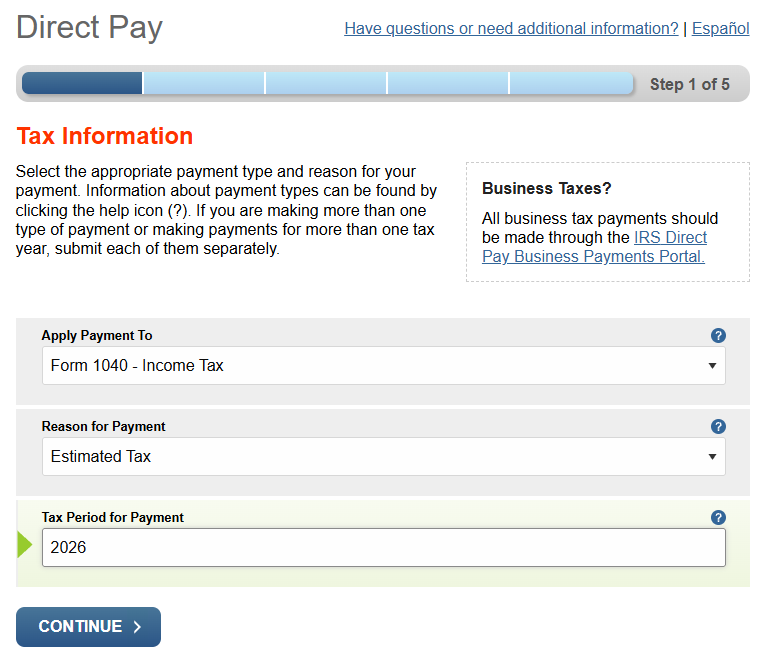
“Apply Payment To” should be “Form 1040 – Income Tax”, “Reason for Payment” should be “Estimated Tax”, and “Tax Period for Payment” is a year box. The payment due January 15, 2027, belongs to tax year 2026, so type 2026 there. The same screen also points business tax payments, such as a C corporation’s December installment, to the separate Direct Pay Business Payments Portal. More on how Direct Pay works is on the IRS Direct Pay page.
Keep the payment record from Direct Pay with your 2026 tax papers. Your bookkeeper will need the dates and amounts of all four payments for the return, and the dates matter for Form 2210. The year-end bookkeeping checklist walks one shop through reconciling every account before the return goes to the preparer, which is when those payment dates get checked.
January 15 estimated tax questions from business owners
What happens if you miss the January 15 estimated tax payment?
You may owe an underpayment penalty for the fourth period, figured on Form 2210 or billed by the IRS. It accrues at the IRS underpayment rate, 7% a year for October through December 2026, until you pay or April 15. Publication 505 lets you skip the payment if you file and pay in full by January 31, 2027.
Can I pay my Q4 estimated tax in December?
Yes. The IRS estimated taxes page says you can pay weekly, monthly or on any schedule, as long as enough is paid by the end of each period. A December payment for tax year 2026 counts toward the fourth period that is due January 15, 2027, so choose 2026 as the tax period.
Do S corporation owners have to make estimated tax payments?
Often, yes. The IRS estimated taxes page lists S corporation shareholders with sole proprietors and partners as people who generally pay estimated tax when they expect to owe $1,000 or more. Withholding from the salary your S corporation pays you counts toward the same safe harbor total.
Does the 110% safe harbor rule apply to everyone?
No. Publication 505 applies 110% of last year’s tax only when your 2025 adjusted gross income was over $150,000, or over $75,000 if you file married filing separately for 2026. Everyone else can use 100% of the 2025 tax, and farmers and fishers follow separate rules.
Bring in a tax professional before you pay if your 2025 return was not a full 12-month return, if you moved between filing statuses, if you owe state estimated tax with different rules, or if you are deciding between the annualized method and a December withholding change. Otherwise, the next step is short: find line 24 on your 2025 Form 1040, add up what you have paid toward 2026, run the calculator above, and schedule the difference in Direct Pay for a date on or before January 15, 2027.
This article is general information based on IRS Publication 505 (2026), the Instructions for Forms 2210 and 2220, the IRS estimated taxes and quarterly interest rate pages, and the IRS Direct Pay screen as published on November 10, 2026. It is not tax or legal advice, and it does not cover state estimated tax, farming or fishing income, trusts, or fiscal-year filers. Rates and forms change, so confirm the figures on IRS.gov or with a tax professional before you pay.
Leave a Reply