

A $60 client gift basket earns a $25 deduction. The client gift deduction limit is $25 per person for each tax year, and the shipping and wrapping can be deducted on top of it.
The rest of the December budget sits under different rules. A party for your staff can be fully deductible, a dinner with a client gets half, and tickets to a game get nothing. For amounts paid after 2025, one more category dropped to zero: food you provide to employees through an on-site eating facility or for your own convenience. This page walks through each of those questions for a small business, then runs the numbers for one hypothetical firm.
Rules quoted here come from IRS Publication 463 (2025 edition) and Publication 15-B (2026 edition), both read on November 6, 2026. The Publication 463 page still shows the 2025 edition.

What is the client gift deduction limit?
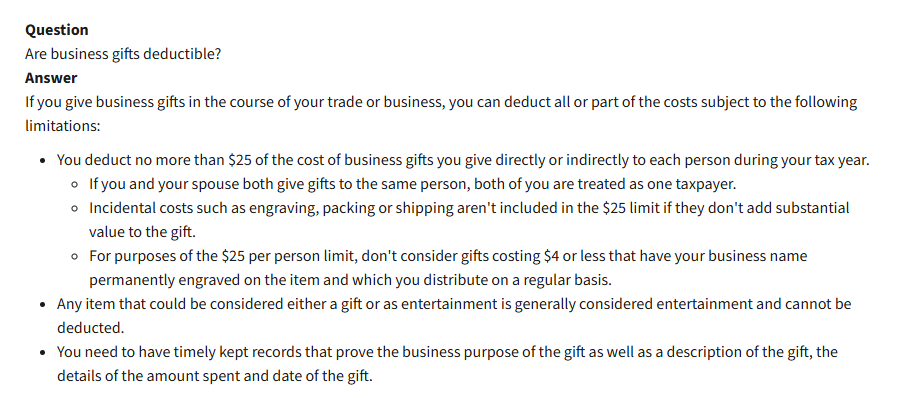
The IRS lets you deduct no more than $25 of business gifts that you give, directly or indirectly, to each person during your tax year. That wording from Publication 463, chapter 3 carries three details owners miss.
First, the cap is per person and per year, so it is shared by every gift that person gets from you. A client who received a $30 bottle of wine in June has already used the whole $25. The December basket for that client adds nothing beyond shipping. A calendar-year business starts a fresh $25 for each person on January 1.
Second, the cap follows the giver as a household or a firm. If you and your spouse both send gifts to the same person, the IRS treats the two of you as one taxpayer, even with separate businesses. A partnership and its partners also count as one giver.
Third, some costs and items sit outside the $25. Engraving, packing, insuring and mailing usually don’t count toward the limit, as long as they don’t add substantial value; gift wrap is the IRS example. An ornamental basket that is worth a lot next to the fruit inside it counts as part of the gift. Items costing $4 or less with your name permanently imprinted, handed out in quantity (pens, desk sets, plastic bags), are not treated as gifts for the limit. Neither are signs or display racks meant for use at the recipient’s place of business.
Who counts as “a person” is also defined. A gift to a company that is meant for the personal use of particular people is an indirect gift to those people. Publication 463’s own example: three $80 baskets sent to a customer’s office and taken home by three executives produce a $75 deduction, $25 for each executive. A gift to a customer’s family member is generally an indirect gift to the customer, unless you have a real business connection with that family member.
Can you deduct a gift card you send to a client?
Publication 463 and the IRS business gifts FAQ contain no separate gift card rule for customers, so the $25 per person cap is the limit to plan around. A $100 card to a client is $100 out of pocket for a $25 deduction at most. Some tax firms take a stricter view of cash-equivalent gifts to clients, so if you plan to send cards in any volume, ask whoever prepares your return before you buy them.
For your own employees the picture is different. Cash and cash-equivalent benefits for staff, gift cards included, are never excludable as a de minimis benefit under Publication 15-B, whatever the amount, so they go through payroll as wages. The holiday bonus withholding walkthrough shows how a gift card handed to staff is added to the next paycheck and taxed.
What does one firm’s December spending actually deduct?
Hypothetical example: a seven-person interior design studio plans its holiday season. Every figure below is invented for illustration; the rules applied to it come from Publications 463 and 15-B.
| December item | Spent | Deductible | Rule applied |
|---|---|---|---|
| 30 client gift baskets at $60 | $1,800 | $750 | $25 per person cap |
| Shipping for those baskets, $12 each | $360 | $360 | Incidental cost, outside the cap |
| 250 pens with the studio logo at $2.80 | $700 | $700 | $4-or-less imprinted items aren’t counted as gifts |
| Staff holiday party at a restaurant | $2,450 | $2,450 | Employee recreation exception, 100% |
| Dinner with two clients, owner present | $380 | $190 | Business meal, 50% |
| Two hockey tickets given to a client | $300 | $0 | Entertainment, no deduction |
| Total | $5,990 | $4,450 | $1,540 not deductible |
The basket line explains most of the gap: $35 of each $60 basket, $1,050 in all, sits above the cap. If four of those 30 clients had already received a $30 bottle of wine from the studio in June, their December baskets would add $0 beyond shipping, and the deductible total for the baskets would fall from $1,110 to $1,010.
To run your own numbers, enter the recipient count, the gift price, and the shipping per box. The fourth field handles people who already got something from you this year.
Client gift deduction calculator
Applies the $25 per person, per tax year limit to one round of identical gifts, with shipping and wrapping kept outside the cap.
Basis: IRS Publication 463 (2025), chapter 3 Gifts, and the IRS FAQ “Are business gifts deductible?” (page reviewed Oct. 16, 2026): $25 per recipient per tax year, incidental costs such as packing and mailing not counted toward the limit, you and your spouse treated as one giver. Checked November 6, 2026. Rounded to the cent. Not covered: imprinted items of $4 or less, gifts to employees, gift cards, entertainment, state rules. Estimate only, not tax advice.
How we checked this calculator
We ran these numbers on Nov 25, 2026: four hypothetical gift rounds worked out by hand from the $25 per recipient, per tax year limit in IRC section 274(b)(1) and the incidental-cost rule in IRS Publication 463, then entered into the calculator above. Set 1 matches the studio’s basket line in the table above.
| Hypothetical inputs | Official-rule result | Calculator result |
|---|---|---|
| Hypothetical 1: 30 people, $60 gift, $12 shipping, nothing given earlier | $750.00 gifts + $360.00 shipping = $1,110.00 deductible; $1,050.00 not deductible | $1,110.00; $1,050.00 |
| Hypothetical 2: 10 people, gift exactly $25, $5 shipping | $250.00 + $50.00 = $300.00 deductible; $0.00 lost | $300.00; $0.00 |
| Hypothetical 3: 8 people, $40 gift, no shipping, $15 already given to each this year | $10 of cap left each: $80.00 deductible; $240.00 not deductible | $80.00; $240.00 |
| Hypothetical 4: 5 people, $20 gift, $8 shipping, $30 already given to each | Cap used up: $0.00 gift cost, $40.00 shipping deductible | $0.00; $40.00 |
What it does not cover: gifts to employees, imprinted items of $4 or less, entertainment, the partnership rule in section 274(b)(2), and state tax rules.
Is the holiday party a gift, a meal, or something else?
It is employee recreation, which has its own exception. Publication 463 lists “recreational expenses for employees such as a holiday party or a summer picnic” among the exceptions to the rule that entertainment isn’t deductible, and again among the exceptions to the 50% limit on meals. The condition that matters most for a small owner-run business is spelled out in the 2026 edition of Publication 15-B:
Food or beverage expenses related to employee recreation, such as holiday parties or annual picnics, remain 100% deductible when made primarily for the benefit of your employees other than employees who are officers, shareholders or other owners who own a 10% or greater interest in your business, or other highly compensated employees. IRS Publication 15-B (2026)
A party for the whole crew where the owner also shows up fits that description. A dinner only for the two partners and the office manager is harder to defend as primarily for rank-and-file staff. Occasional parties or picnics for employees and their guests also appear on the IRS list of de minimis benefits, so the party is not added to anyone’s W-2.
Client events follow the meal and entertainment rules instead. You can deduct 50% of a business meal with a client when you or an employee is present and the meal isn’t lavish or extravagant. Tickets to a game, a concert or a theater are entertainment and get no deduction. Publication 463 adds a useful tiebreak: an item that could be either a gift or entertainment is generally treated as entertainment, but packaged food or drinks a customer will use later count as a gift. If a ticket invoice lists food and drinks as a separate line, that food can still be a 50% meal.
What changed for office food in 2026?
From 2018 through 2025, employers could deduct 50% of de minimis meals for staff. For amounts paid or incurred after 2025, the 2026 edition of Publication 15-B says an employer can no longer deduct food and beverages provided to employees through an eating facility that meets the de minimis rules or provided for the convenience of the employer. Public Law 119-21, enacted in 2025, carved out limited exceptions for certain industries and for meals provided by restaurants; section 274(o) of the tax code has the details.
The employee side did not change: the same publication says the fringe benefit exclusion rules still apply, so those meals can still stay off W-2s. For your books, the practical step is to stop lumping all December food into one “meals” account. Put the staff party, client meals, and any regular staff kitchen or catered lunches in separate accounts or tags, so whoever prepares the 2026 return can apply 100%, 50% and 0% without digging through receipts.
How are holiday gifts to your own employees handled?
Staff gifts are a wage question first. Among the de minimis benefits you can leave out of wages, the IRS names “holiday or birthday gifts, other than cash, with a low fair market value,” such as a ham, a fruit box, or a modest bottle of wine. Cash and gift cards are always wages, as covered above. The IRS sets no dollar line for “low” value, so keep these gifts modest and occasional; a $400 watch is hard to call low value.
Length-of-service and safety awards are a separate exclusion with their own conditions in Publication 15-B, including that the award be tangible personal property presented as part of a meaningful presentation. Cash, gift cards, meals, tickets and vacations don’t qualify for it. If you plan a five-year or ten-year award this December, read that section before choosing the item.
What records does the IRS want for each gift?
The substantiation rules in Treasury Regulation section 1.274-5T name five things to prove for a business gift: the cost, the date, a description of the gift, the business reason for it, and the recipient’s business relationship to you (name, title or other information that shows the connection). The IRS FAQ adds that the records need to be kept at the time, not rebuilt in April.
A card statement line that reads “gift basket order, $1,800” proves the amount and the date. It doesn’t show 30 recipients, which is what the per-person cap depends on. Keep the order confirmation with the recipient list next to it, and note any gifts the same people received earlier in the year. If you already scan receipts, the receipt tracking guide covers what the IRS expects from a stored image, and the year-end checklist lists the other December and January deadlines.
Before the first box ships, start a gift log with five columns: date, recipient and company, what it was and its price before shipping, shipping and wrapping, and the business reason. Then scroll back through this year’s card statements for anything already sent to the same people since January 1, so the cap you apply in December is the cap you actually have left.
This article is general information about federal tax rules, not tax or legal advice for your situation. State rules can differ. For your own return, check IRS Publication 463 and Publication 15-B or ask a tax professional.
Leave a Reply