

A gift card scam from your boss is a text or email that borrows the owner’s name to get an employee to buy gift cards and send the codes. What stops it is a rule every employee hears before it happens: this business never asks anyone to buy gift cards, so any message that does is fake, and the answer is a call to the owner’s known number.
The FTC and FBI figures and the exact scam wording quoted below were checked on their official pages on November 5, 2026.
The story below is a hypothetical office, built from the patterns the FTC describes in its alerts. Follow it once, then use the sections after it to set the rule, handle a loss that already happened, and decide who pays.
A Tuesday in December at a nine-person dental office (hypothetical)
Harbor Street Dental has one dentist who owns the practice, four hygienists and assistants, two front desk staff, a billing coordinator and an office manager named Rosa. The owner’s name and photo are on the practice website, and Rosa’s title is on her LinkedIn profile. That is all a scammer needs.
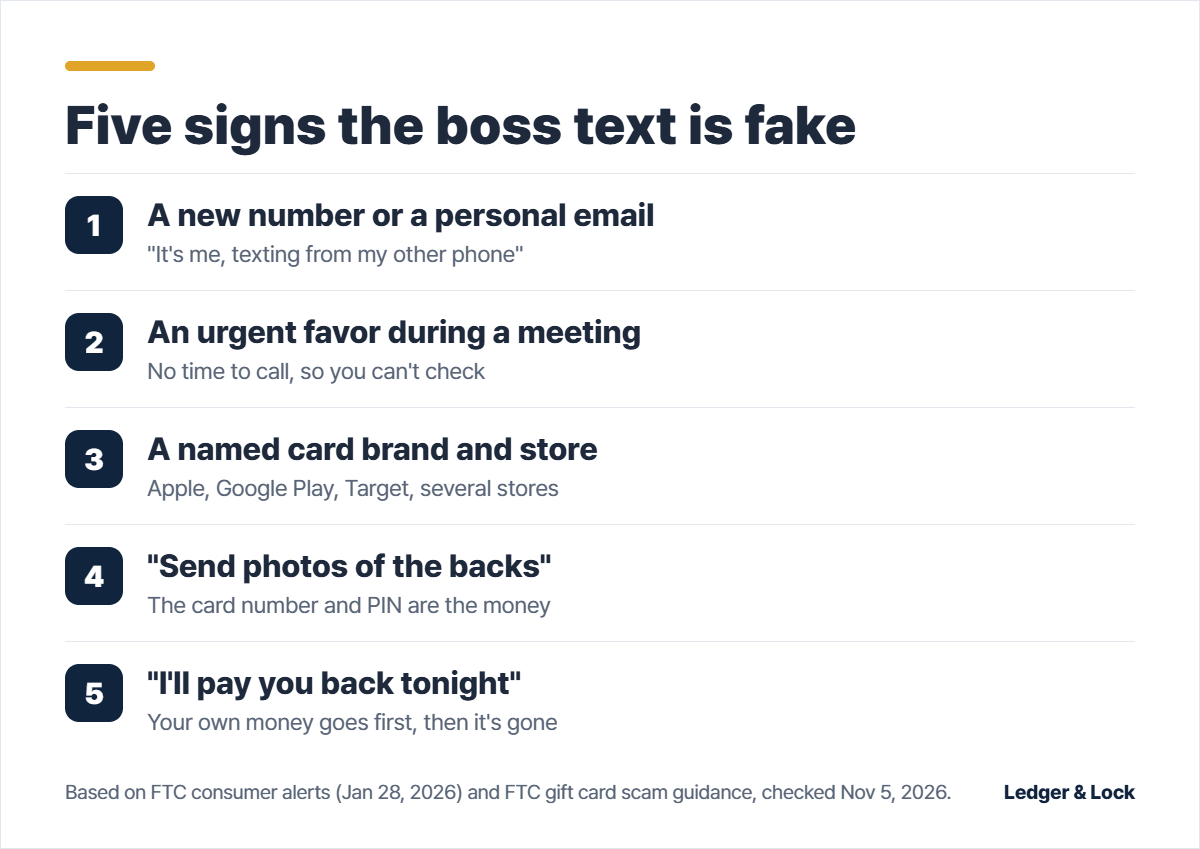
At 10:41 a.m. Rosa gets a text from a number she doesn’t know: “Hi Rosa, it’s Dr. Patel. Stuck in a meeting, can’t talk. Quick favor before lunch, are you at the desk?” She answers yes. Five minutes later: “I want to surprise the hygiene team. Pick up four $250 Apple gift cards at the pharmacy, keep the receipt, and text me photos of the backs. I’ll pay you back tonight.”
Rosa uses her own debit card, because the practice card is in the owner’s office. By 11:25 she has sent photos of four cards, $1,000 in total. At 11:32 a new text asks for two more “for the front desk.” That second request is what makes her stop. She opens the staff contact sheet, calls Dr. Patel’s cell, and reaches him between patients. He never sent anything.
Every step Rosa took matches what the FTC’s January 2026 alert on boss gift card scams lays out: an unexpected message, an “urgent favor,” a trip to the store, and a request for the numbers on the back of the cards. The alert adds that scammers sometimes ask for “Google certificates,” a vague phrase meant to get you to reply and ask what they mean.

Why the gift card scam from boss texts works on small teams
A 40-person company usually has a purchasing process and someone in accounting who would question a $1,000 card run. In a nine-person office the person who gets the text is often the person who buys things. The owner is genuinely busy and genuinely hard to reach during the day, so “I’m in a meeting” sounds normal. The request is also small enough that an eager employee covers it personally.
New hires are the easiest target. The FTC’s business guidance on onboarding new employees warns that scammers follow hiring updates on social media and contact new staff, sometimes before their first day, with an urgent request from the new “boss” to buy gift cards or text personal and financial details. Someone who started last week has no idea how the owner normally communicates.
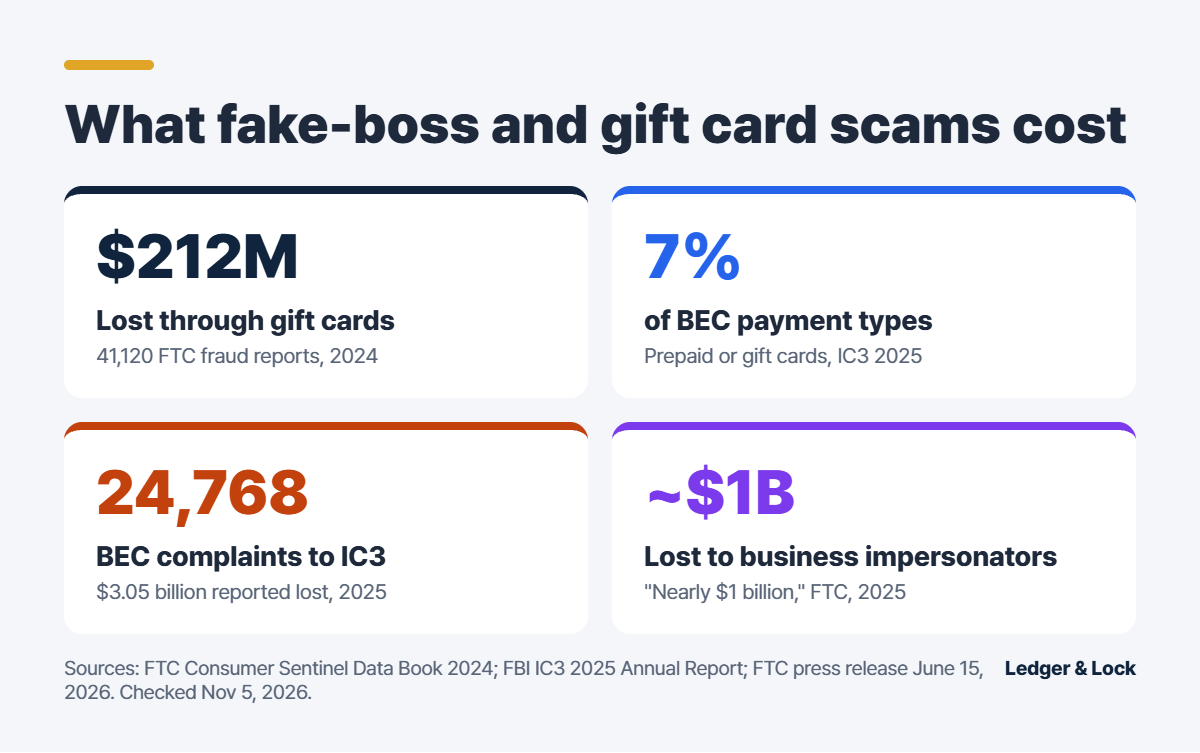
The money adds up. Fraud reports to the FTC that named a gift card or reload card as the payment method totaled 41,120 in 2024, with $212 million reported lost, according to the Consumer Sentinel Network Data Book 2024. Business email compromise, the wider family this scam belongs to, drew 24,768 complaints and $3,046,598,558 in reported losses in 2025 in the FBI IC3 2025 Annual Report. In that report’s breakdown of how BEC victims paid, prepaid and gift cards made up 7%, far behind wire and ACH transfers at 86%. The FTC also says people reported losing nearly $1 billion to business impersonators in 2025 (FTC press release, June 15, 2026).
The wire-transfer version of the same trick, where a fake vendor or executive asks for a payment to a new bank account, is covered in our guide on how to prevent business email compromise before you wire money. The gift card version is smaller per incident, but it reaches staff who never touch a bank login.
The office rule that would have stopped it at 10:46
What Rosa lacked at 10:46 was one fact she could have learned on her first day: the owner would never ask for gift cards. The FTC’s onboarding guidance makes the same point to employers: if you are unlikely to ask staff to buy gift cards as part of their job, tell them that, so any message asking for them reads as a scam. Write the rule in plain words and give it to everyone, including temps and anyone who has accepted an offer but hasn’t started.
- No gift cards, ever. “This business never asks anyone to buy gift cards or send card numbers, by text, email, call or chat. A request like that is fake even if it uses my name or my photo.”
- Name the real channels. “I contact staff from my cell ending in 4471, my practice email and the team chat. A message from any other number or address gets a call back to the number on the staff sheet before you do anything.” Swap in your own last four digits.
- Staff gifts go through the business. “Gifts and party supplies are bought on the practice card, and the receipt goes to billing the same day.” A real surprise for the team never needs an employee’s own money.
- Stopping is always safe. “Nobody gets in trouble for calling me to check, even in the middle of a patient.” Scammers count on people being afraid to interrupt.
“Only scammers will tell you to buy a gift card, like a Google Play or Apple Card, and give them the numbers off the back of the card.” FTC, Avoiding and Reporting Gift Card Scams
Look at how Dr. Patel’s name got into the text, too. A text from a strange number needs no hacking at all. An email that appears to come from the owner’s real address is different: it means either the domain can be spoofed or the mailbox was taken over. Spoofing is what SPF, DKIM and DMARC records block, as explained in our SPF, DKIM and DMARC walkthrough, and a hijacked mailbox is what MFA on every business account is for.
The bait can change while the trick stays the same. A fake benefits notice may carry a QR code and a sign-in request instead of a gift card errand, and the defense is the same habit of going to the system you already know, as the QR code phishing example hidden in a fake benefits email shows.
If an employee already sent the card numbers
The card number and PIN are what the scammer spends, so the clock starts the moment the photo is sent. The FTC says to report it to the card company right away, no matter how long ago it happened, and to ask for the money back. Some issuers can freeze a card if the balance is still on it. In Rosa’s case, this is the first hour:
- Call the issuer while she still holds the cards. For Apple cards the FTC lists 1-800-275-2273 (say “gift card” to reach a person) and notes Apple can freeze a card that still has money on it. Google Play scams are reported through Google’s online form, and Target’s line is 1-800-544-2943. Other brands are on the FTC gift card scam page, or on the back of the card.
- Keep the cards and receipts. Photograph the front and back of each card and the store receipt. The issuer will ask for both.
- Report it to the FTC at ReportFraud.ftc.gov. If the request came from a business email account that was actually taken over, also file at ic3.gov, change that account’s password, turn on MFA and check its mail forwarding settings.
- Warn the rest of the staff the same day. The scammer had Rosa’s name and the owner’s name, so other employees may get the same texts. Tell them what the message said and which number it came from.
If the scammer used the owner’s real mailbox, the problem is bigger than $1,000, because someone else can read that inbox. Our checklist on what to do after a data breach covers who else to notify if patient or customer data was in that mailbox.
The no-gift-cards rule is one of two written money rules in our ordered cyber security plan for small businesses; the other is a call-back before any change to a payee’s bank details.
Who pays for the cards, and what to send staff today
Rosa spent $1,000 of her own money because she believed her employer asked her to. Suppose Apple freezes two of the cards before they are drained and returns $500. The remaining $500 is the practice’s decision. Reimbursing it is the simplest choice: the scam ran on the business’s name, and $500 is small next to losing a trusted manager’s goodwill. If you would rather treat it as the employee’s loss, check your state labor department’s rules on paycheck deductions before you take anything out of wages.
Decide this in advance and put it in the same rule: “If you are tricked anyway, tell me right away. Reporting it fast matters more than the money.” People who fear blame wait, and waiting is what lets the scammer spend every card.
Today, send one message from your real number to every employee and every new hire who hasn’t started yet: “This is my only cell number. I will never ask you to buy gift cards or send card numbers. If anyone using my name does, call me at this number before you do anything.” Ask each person to save the number under your name, then add the same lines to your onboarding packet so next month’s hire sees them before their first day.
This article is general information about a common impersonation scam, based on FTC and FBI pages as published on November 5, 2026. It is not legal, employment or professional security advice, and it does not cover your state’s wage-deduction laws or any insurance claim. For your own situation, see the FTC’s guidance on gift card scams, report losses at ReportFraud.ftc.gov, and ask an attorney or your insurer about reimbursement questions.
Leave a Reply