
A bookkeeper who also prepares a few hundred personal tax returns, a two-person mortgage brokerage, a used car lot that writes its own financing: none of these feel like a bank, yet each one is a “financial institution” under the FTC’s Safeguards Rule. The rule (16 CFR Part 314) tells these businesses how to protect customer information, and since May 13, 2024 it has also required them to report certain breaches to the FTC within 30 days.
The rule text quoted here was read on eCFR (16 CFR Part 314) in October 2026.
This guide is for owners and office managers who are not sure the rule reaches them. It is organized around the questions owners ask most, in the order they come up: whether the business is covered, whether the small-firm exemption helps, and what is owed either way. By the end you should know whether you need a written security program, which parts the small-firm exemption removes, and which parts stay no matter how small you are.
Does your business count as a “financial institution”?
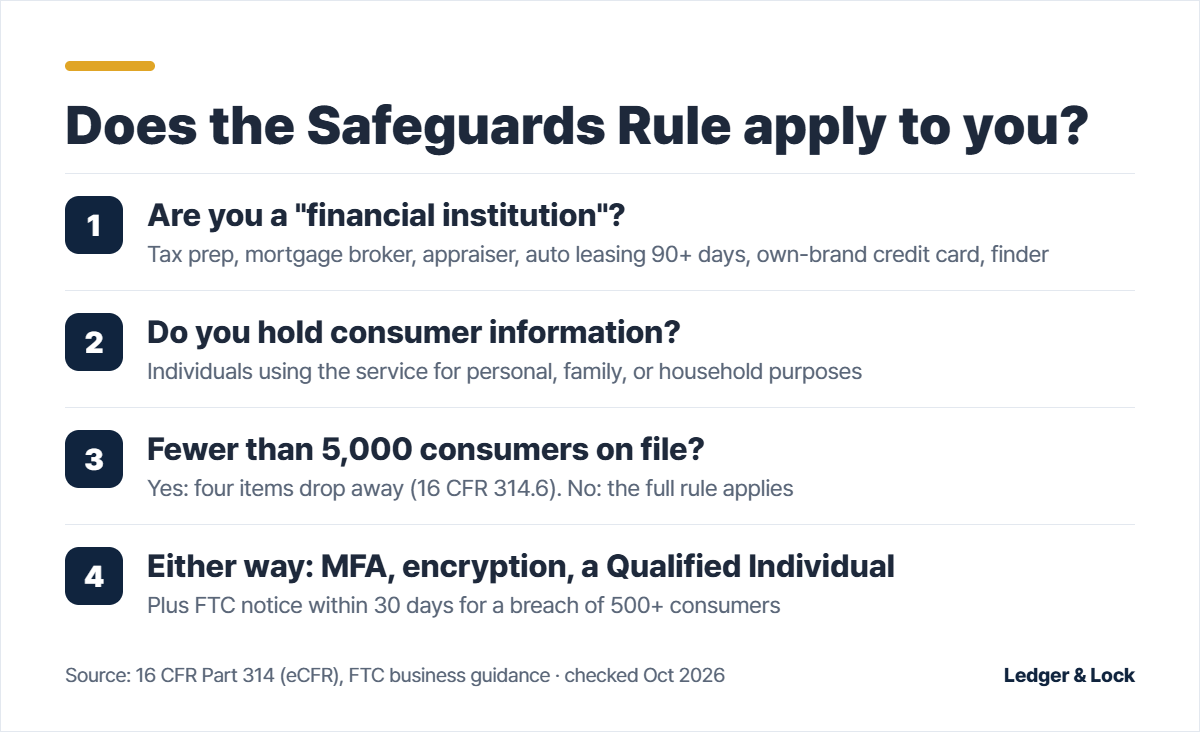
Coverage reaches businesses under FTC jurisdiction that are “significantly engaged” in financial activities. Section 314.2 of the rule lists 13 examples. The ones most likely to describe a small US business are:
- An accountant or tax preparation service that completes income tax returns
- Mortgage brokers, and businesses that provide real estate settlement services
- Personal property or real estate appraisers
- An auto dealer that, as a usual part of its business, leases vehicles for longer than 90 days
- A retailer that issues its own credit card directly to consumers
- Check cashers, businesses that regularly wire money for consumers, and credit counseling or investment advisory firms
- A “finder” that brings buyers and sellers together for deals they negotiate themselves (added in the 2021 amendments)
The same section also lists what does not make you a financial institution. A shop that accepts cards issued by others, offers occasional layaway or deferred payment, or lets a regular customer run a tab is not covered for those reasons alone. A grocery store that cashes a check for a shopper is not covered either. Many restaurants, salons, and contractors that only take card payments fall in this group.
One more filter matters. What gets protected is information about consumers, meaning individuals who get a financial product or service for personal, family, or household use. A firm that only does bookkeeping for other businesses may hold very little consumer data. A firm that also files personal Form 1040 returns holds a lot. The FTC staff guide for businesses suggests rechecking the definition as your services change, because a new line of work can pull you in.
Does keeping fewer than 5,000 consumers get you out of it?
Section 314.6 exempts financial institutions that “maintain customer information concerning fewer than five thousand consumers” from four specific requirements. Everything else in the rule still applies to them. Here is how the requirements in 16 CFR 314.4 split by size:
- Required at any size: a Qualified Individual named to run the program; access controls, encryption, MFA, secure disposal, and logging; regular testing or monitoring of safeguards; and notifying the FTC of a breach affecting 500 or more consumers.
- Required at any size, in two versions: the risk assessment. Under 5,000 consumers you still do one, but the written-criteria version in (b)(1) is not required. At 5,000 or more it must be written, with set criteria.
- Required only at 5,000 or more: continuous monitoring, or an annual penetration test plus vulnerability scans every six months; a written incident response plan; and an annual written report to the board or a senior officer.

The count is about information you maintain, so it is safer to count every consumer whose records you still hold, not only this year’s clients. A tax office that has kept seven seasons of client files on a shared drive may be over the line even if it filed 900 returns this year. Shrinking old files can move you under it. You are already expected to dispose of customer information no later than two years after you last used it to serve that customer, unless you have a legal or business reason to keep it.
The small-firm exemption removes four paperwork and testing items. It does not remove MFA, encryption, a named Qualified Individual, or the duty to tell the FTC about a breach involving 500 or more consumers.
What does a covered business owe, whatever its size?
If your business is covered, these are the controls the FTC guide walks through as part of a reasonable program. Work through them in the order shown, because the data list and risk assessment show where the later controls matter most.
- Name a Qualified Individual. This can be an employee or someone at an outside IT provider. According to the FTC guide, no particular degree or title is required. If you use a provider, you still own compliance and must name a senior person on your side to supervise them.
- List your data and systems. Write down where customer information lives: tax software, email, cloud storage, paper files, laptops, phones.
- Assess the risks. For each place on the list, note what could go wrong and what protects it today. Firms under 5,000 consumers do not need the formal written criteria, but they still need to do this and repeat it periodically.
- Limit access. Each person should reach only the customer information their job needs.
- Encrypt. Customer information must be encrypted in transit over external networks and at rest. If that is not feasible, your Qualified Individual must review and approve other controls.
- Turn on MFA for anyone accessing an information system. An exception is allowed only if your Qualified Individual approves an equivalent or stronger control in writing. Our MFA setup checklist covers which accounts to switch first.
- Set a disposal schedule that meets the two-year rule above, and review your retention policy periodically.
- Log user activity and manage changes. Adding a new server, app, or remote access tool should trigger a quick security review.
- Train staff with security awareness training updated to the risks you found.
- Check your vendors. Pick service providers that can protect the data, put safeguards in the contract, and reassess them periodically.
Tax and accounting firms have a ready template. IRS Publication 5708 is a sample Written Information Security Plan built for small practices, and IRS Tax Tip 2026-49 (June 16, 2026) states that a WISP is required by law for tax professionals. Publication 5708 says tax and accounting professionals are financial institutions under the rule “regardless of size.”
For a one-person practice, the sample WISP for a sole proprietorship tax office fills in that template section by section for a hypothetical solo preparer.
When do you have to tell the FTC about a breach?
This is the one duty with no size exemption at all. Section 314.4(j) applies to every covered business. If unencrypted customer information about at least 500 consumers is acquired without authorization, you must notify the FTC as soon as possible and no later than 30 days after discovery. Encrypted data counts as unencrypted if the key was also exposed. Unauthorized access is presumed to be acquisition unless you have reliable evidence that the data was not, and could not reasonably have been, taken.
The clock starts on the first day the event is known to any employee, officer, or agent other than the person who committed the breach. A receptionist who notices a strange forwarding rule in the shared inbox on a Monday may have started your 30 days that Monday.

The report goes through the FTC’s Safeguards Rule Security Event Reporting Form. According to the FTC guide, it asks for high-level facts: company name and contact details, the start and end dates of the event, the number of consumers affected or possibly affected, the types of information involved, and a short summary. You can file what you know and send an updated report later. Expect that your report may be made public, as the FTC guide warns. If police have asked you to hold off on publicity, check the “Law Enforcement Delay Requested” box.
Filing with the FTC does not replace state breach laws. In the agency’s own words on its business blog, Safeguards Rule compliance is no substitute for obligations under other state and federal laws, so check your state’s notice rules too.
Your website’s privacy notice is a separate question from the Safeguards Rule. If the site collects names or email addresses from California residents, CalOPPA can require a posted policy whether or not this rule covers you, and the guide on what a small business website privacy policy should include goes through the required sections.
The FTC notice is only one of the clocks. State breach-notification laws run on their own deadlines, and our guide to what to do after a data breach at your small business lays out the timelines in California, New York, Texas and Florida.
Where would three typical firms land?
These examples are made up to show how the questions combine. Your facts may differ.
- Solo preparer, 1,200 individual returns a year, files kept since 2019. Covered, because it does tax preparation. It is possibly in the 5,000+ tier once old files are counted, so the first task is to count every consumer on file, then purge under the two-year rule.
- 12-person mortgage brokerage, about 3,000 applicants on file. Covered as a mortgage broker and under 5,000. First task: name a Qualified Individual and turn on MFA.
- Coffee shop that takes cards and runs tabs for regulars. Not covered for those activities, so no tier applies. First task: follow general FTC data security guidance.
Notice that the first firm’s tier depends on recordkeeping, not on how busy it was this year. The coffee shop still has security duties under other laws and card network rules, but not this rule for taking payments.
Even if the rule does not reach your business, MFA, offline backups and a breach plan are still worth having, and the small business cyber security checklist lays them out in the order to set them up.
What do small firms get wrong most often?
- Assuming “we are not a bank” ends the question. An FTC blog post on the notice requirement lists tax preparation firms, mortgage brokers, and collection agencies among the covered types and says the list is not exhaustive.
- Treating the 5,000-consumer exemption as a full pass. It removes four items only.
- Letting an IT vendor hold the role with no one inside the business supervising them.
- Keeping every client file forever “just in case,” which raises both your count and your exposure.
- Waiting for a full forensic report before contacting the FTC. You can file with what you know and update later.
Safeguards Rule checklist for a small firm
- Match your services against the 13 examples in 16 CFR 314.2.
- Count the consumers whose information you hold, including old files.
- Name a Qualified Individual and, if outsourced, a senior supervisor inside the firm.
- Write down where customer data lives and the main risks to each place.
- Confirm MFA and encryption on email, tax or loan software, and cloud storage.
- Set a disposal date for records older than two years since last use.
- Add security terms to vendor contracts.
- Bookmark the FTC reporting form and note who files it.
- If you are at 5,000 or more, add the written risk assessment, testing schedule, incident response plan, and annual report.
Your next step: this week, pull a count of every individual client or applicant record in your systems and on paper. That one number tells you which side of the 5,000-consumer line you are on. Then open the FTC guide or, for tax firms, Publication 5708 and start filling in the Qualified Individual and data inventory sections. For breach response steps beyond the FTC notice, the FTC’s Data Breach Response: A Guide for Business covers the rest.
This article is general information, not legal, tax, or professional IT advice. Rule text and agency guidance can change. For your situation, read 16 CFR Part 314 on eCFR and the FTC’s business guidance, and consider a qualified attorney or security professional.
Leave a Reply