

FreshBooks vs Wave vs QuickBooks Solopreneur is mostly a fight over payment fees. On a sample $9,600 month, fees run roughly $210 to $215 at every vendor, while the plans that fit cost $0 to $43.
That gap shapes the whole comparison. A freelancer who bills a few thousand dollars a month pays more in payment fees than for any of these subscriptions, so the cheapest plan is not always the cheapest month. This page lines up the three vendors’ published plan prices and fee tables, then prices one hypothetical month and gives you a calculator for your own.
Prices and rates below come from each vendor’s US pricing page and help center, read on October 29, 2026. QuickBooks labels its rate table “accurate as of 09/18/2026.”
What to settle before you compare invoicing tools
Four facts about your own billing decide most of this. Write them down from last month’s invoices before you open any pricing page:
- How many clients you bill. FreshBooks prices by billable clients, so 6 clients and 60 clients land on different plans.
- How many invoices go out. The free QuickBooks tier stops at 2 invoices a month.
- How clients pay. Card, bank transfer (ACH), or check. Business clients often pay with a company card, and FreshBooks charges more for those.
- What else you need from the tool. Bank feeds, receipt capture, mileage, paying contractors, or an accountant login. These features, not invoicing, are what the paid tiers mostly sell.
This comparison covers US businesses invoicing in US dollars. It leaves out payroll add-ons, international clients and in-person card readers.
FreshBooks vs Wave vs QuickBooks Solopreneur plan prices
The table shows regular monthly prices as listed, with the limits each page puts in the plan card. All three were running introductory discounts on the day of the check: FreshBooks showed 80% off for 4 months, QuickBooks showed 50% off for 3 months on its paid tiers, and Wave listed Pro at $190 a year on annual billing, $38 less than paying monthly. Budget for the regular price, because that is what renews.
| Plan | Regular price | Limit that matters | Also listed on the plan card |
|---|---|---|---|
| Wave Starter | $0 | Unlimited invoices and estimates | Online payments optional, mobile app |
| Wave Pro | $19/mo or $190/yr | Priced per business, not per owner | Bank import, unlimited receipts, automated late-payment reminders |
| FreshBooks Lite | $23/mo | 5 billable clients | Estimates, expense tracking, tax-time reports |
| FreshBooks Plus | $43/mo | 50 billable clients | Proposals, retainers, receipt scanning, accountant access |
| FreshBooks Premium | $70/mo | Unlimited clients | Project profitability, custom email templates |
| QuickBooks Solopreneur Free | $0 | 2 invoices, 2 receipts, 5 mileage trips a month; 1 contractor | Accept payments, income and expense tracking |
| QuickBooks Lite | $20/mo (rechecked Nov 25, 2026; $10 on Oct 29) | Unlimited invoices; 3 contractors | Unlimited receipts and mileage, instant deposit |
| QuickBooks Simple Start | $38/mo | Unlimited contractors | Accountant access, recurring payments, cash flow history |
Sources: Wave pricing, FreshBooks pricing and QuickBooks Solopreneur plans. FreshBooks also sells add-ons on every plan: team members at $11 a month per user and Advanced Payments at $20 a month. The QuickBooks offer terms on that page say the discount applies to new monthly subscriptions for the first 3 months, and after that you pay the then-current price.
What each one keeps when a client pays online
All three let a client click “pay” on the invoice. The fee comes out of the payment before it reaches your bank. Here is the published rate for each payment type.
| Payment type | Wave | FreshBooks | QuickBooks |
|---|---|---|---|
| Visa, Mastercard, Discover (consumer) | 2.9% + $0.60 (Pro: 2.9% + $0 on the first 10 a month) | 2.9% + $0.30 | 2.99% |
| Business, commercial or corporate card | No separate rate listed | 3.5% + $0.30 | No separate rate listed |
| American Express | 3.4% + $0.60 (Pro: 3.4% + $0 on the first 10) | 3.5% + $0.30 | 2.99% |
| Bank transfer (ACH) | 1%, $1.00 minimum | 1% | 1% |
| Faster payout | Not listed in the fee table | Instant payouts +1.5% | Instant deposit 1.75% |
Sources: Wave online payments fees and timelines, FreshBooks Payments fees (USD) and QuickBooks payment rates. The FreshBooks table separates standard cards from “commercial, corporate, business, and American Express” cards, which matters if your clients are companies.
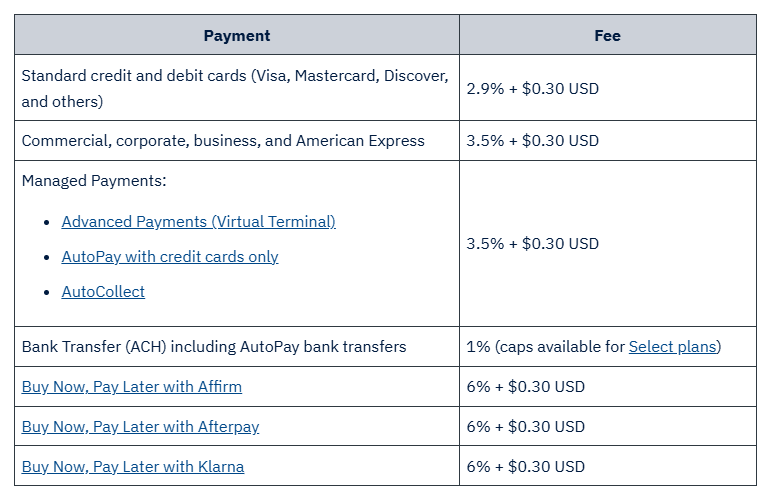
If most of your clients are businesses that pay by company card, price FreshBooks at 3.5% + $0.30, not the 2.9% headline rate.
Payout timing differs too. Wave’s help article lists 2 business days for US card payments and 2 to 7 business days for bank payments, and says the timelines cannot be expedited. FreshBooks charges an extra 1.5% if you want an instant payout, and QuickBooks charges 1.75% for instant deposit.
Small invoices and big invoices: where the fee math flips
Flat fees and percentage fees behave differently as the invoice grows. QuickBooks charges a straight 2.99% with no fixed part, while FreshBooks adds $0.30 and Wave Starter adds $0.60 to a 2.9% rate.
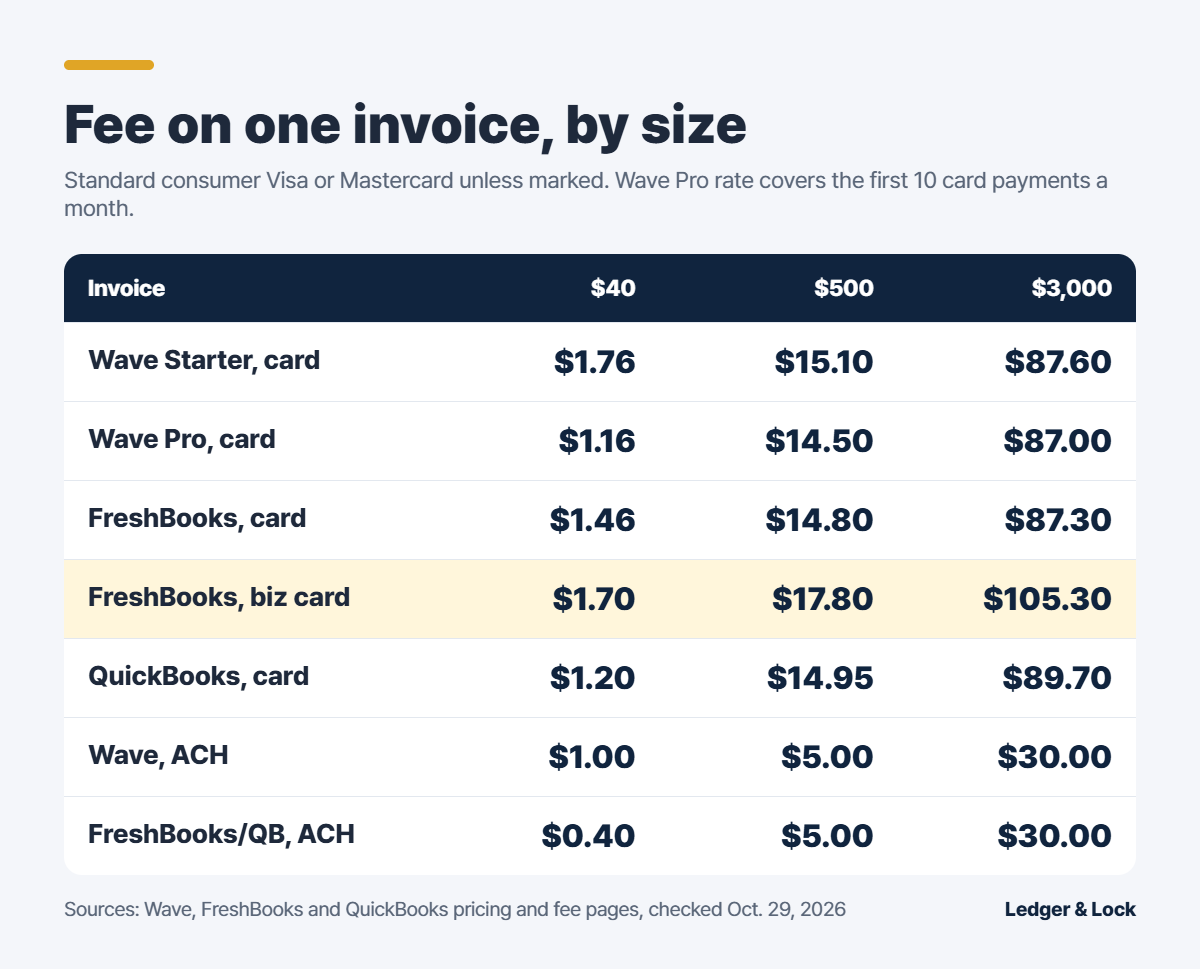
The crossover points are simple division. The extra 0.09% QuickBooks takes equals FreshBooks’ 30 cents at about $333 and Wave Starter’s 60 cents at about $667. Below those amounts QuickBooks costs less per card payment, and above them it costs a little more. On a $3,000 invoice the spread between consumer-card rates is under $3, so for large invoices the plan price and the payment method matter far more than the card rate.
Bank transfers flip the picture for small bills. A tutor or dog walker sending $40 invoices pays Wave’s $1.00 minimum on each ACH payment, which works out to 2.5% of the bill, while FreshBooks and QuickBooks take $0.40.
Does Wave Pro pay for itself in fees?
Not on fees alone. Pro removes the $0.60 fixed part on the first 10 card payments each month, so the largest possible saving is 10 × $0.60 = $6.00 a month. The plan costs $19 a month, or about $15.83 a month on the $190 annual price.
Wave Pro makes sense when you want what else it includes: automatic bank imports, merged and categorized transactions, unlimited receipt capture and automated late-payment reminders. For receipts alone, Wave’s pricing page lists a separate add-on at $8 a month or $72 a year. If you only send invoices and track payments, Starter does that job for $0.
Limits that push you onto a pricier plan
Each vendor caps a different thing, and the cap decides which plan you actually pay for.
FreshBooks counts billable clients. Lite covers 5, so a sixth client moves you to Plus and raises the regular bill from $23 to $43 a month. Count clients you invoice over a year, not just this month, because a client you bill once a quarter still counts. Wave does not cap clients or invoices on either plan. QuickBooks caps invoices on the Free tier at 2 a month and caps contractors you can manage: 1 on Free, 3 on Lite, unlimited on Simple Start.
E-signature plans cap a different unit again: DocuSign Standard counts envelopes, 100 per user a year, while paid Dropbox Sign plans list unlimited requests, a gap the DocuSign vs Dropbox Sign pricing breakdown works through for a two-sender office.
Accountant access is the other common trigger. FreshBooks lists “Give your accountant access” from Plus up, and on the QuickBooks page Simple Start is the first tier marked “With accountant access.” If your bookkeeper or tax preparer logs in, start the comparison at those tiers. Our QuickBooks vs Xero pricing for a 5-person team goes further up the QuickBooks Online range if you expect to outgrow a solo plan.
One month priced out for a hypothetical freelance designer
Hypothetical: Juniper Studio is a one-person brand designer with 6 active clients. In a typical month 8 invoices of $1,200 get paid, $9,600 in total. Five clients pay by card and 3 pay by bank transfer. Here is that month at regular list prices on the cheapest plan each vendor allows for 6 clients and 8 invoices.
- Wave Starter, $213.00. Five card payments at $35.40 each (2.9% + $0.60) come to $177.00, three ACH payments at $12.00 add $36.00, and the plan is free.
- QuickBooks Lite, $235.40. At a flat 2.99%, each card payment costs $35.88, so 5 of them total $179.40. Add $36.00 of ACH fees and the $20 plan (Lite was $10 on Oct 29 and $20 when rechecked on Nov 25, 2026). The Free tier is out because it allows only 2 invoices.
- Wave Pro, $229.00. All five card payments fall inside the first 10 of the month, so each costs $34.80 for $174.00 in total. ACH adds $36.00 and the plan $19.
- FreshBooks Plus, $254.50. Card fees are 5 × $35.10 (2.9% + $0.30) = $175.50, and ACH is again $36.00. The plan is $43 because 6 clients is over the Lite limit of 5.
Now change one assumption. If two of those five card payers use company cards, FreshBooks applies 3.5% + $0.30 to them, which adds $14.40 and brings its month to $268.90. Change a different one instead: if all 8 clients paid by ACH, every vendor’s fees would drop to $96.00, and the four totals would fall to between $96.00 and $139.00. Getting clients onto bank transfer saves more than any plan switch here. Our Stripe vs Square vs PayPal fee comparison shows the same pattern for invoices sent through payment processors directly.
To run your own month, enter your numbers below. It uses regular list prices and standard consumer card rates, and it should reproduce the Juniper Studio totals with 8 invoices, $1,200, 62.5% by card and 6 clients.
Invoicing cost calculator: Wave, QuickBooks, FreshBooks
Enter one typical month. The calculator picks the cheapest plan at each vendor that allows your invoice and client count, then adds the published online payment fees for card and bank (ACH) payments.
Basis: Wave pricing page and Wave Help Center fee table, FreshBooks pricing page and FreshBooks Payments (USD) fee article, QuickBooks Solopreneur plans page and QuickBooks payment rates page, all as displayed on October 29, 2026 (QuickBooks states its rates are accurate as of 09/18/2026). Regular monthly list prices, not introductory discounts: Wave Starter $0, Wave Pro $19; FreshBooks Lite $23 (5 clients), Plus $43 (50 clients), Premium $70 (unlimited); QuickBooks Free $0 (2 invoices a month), Lite $20 (rechecked November 25, 2026; it was $10 on October 29). Card fees for standard Visa or Mastercard consumer cards: Wave Starter 2.9% + $0.60, Wave Pro 2.9% + $0 on the first 10 card payments each month and then 2.9% + $0.60 (Wave’s footnote says the first ten transactions; this calculator counts card payments); FreshBooks 2.9% + $0.30; QuickBooks 2.99%. Bank transfers: 1% at all three, with a $1.00 minimum at Wave. Each fee is rounded to the cent per payment. Not covered: Amex, business and commercial cards (FreshBooks charges 3.5% + $0.30 on those), international cards, instant payouts, chargebacks, add-ons such as team members or payroll, sales tax, and annual billing. Prices change; check each vendor’s page before you sign up. Estimate only.
How we checked this calculator
We ran these numbers on Nov 25, 2026. Each hypothetical month was priced by hand from the Wave pricing page and Wave fee table, the FreshBooks pricing page and FreshBooks Payments fee article, and the QuickBooks Solopreneur plans page and QuickBooks payment rates page, then entered into the calculator above. The check found that QuickBooks Lite now lists a regular price of $20 a month, up from $10 on Oct 29, so the calculator and the Lite figures on this page were updated. Every other price and fee matched.
| Hypothetical month | Totals from the published prices (Wave Starter · Wave Pro · FreshBooks · QuickBooks) | Calculator result |
|---|---|---|
| Set A: 2 invoices of $80, 1 by card, 1 by ACH, 3 clients (Wave $1 ACH minimum, QuickBooks Free 2-invoice limit) | $3.92 · $22.32 · $26.42 (Lite) · $3.19 (Free) | $3.92 · $22.32 · $26.42 · $3.19 |
| Set B: 12 invoices of $500, all by card, 5 clients (Wave Pro past its first 10 card payments, FreshBooks Lite at its 5-client limit) | $181.20 · $194.20 · $200.60 (Lite) · $199.40 (Lite) | $181.20 · $194.20 · $200.60 · $199.40 |
| Set C: 3 invoices of $2,500, all by ACH, 51 clients (one over FreshBooks Plus) | $75.00 · $94.00 · $145.00 (Premium) · $95.00 (Lite) | $75.00 · $94.00 · $145.00 · $95.00 |
| Juniper Studio example above: 8 invoices of $1,200, 62.5% by card, 6 clients | $213.00 · $229.00 · $254.50 (Plus) · $235.40 (Lite) | $213.00 · $229.00 · $254.50 · $235.40 |
The calculator does not cover Amex or business cards, instant payouts, chargebacks, introductory discounts or annual billing. Prices and fees change, so check each vendor’s page before you sign up.
Which tool fits which kind of freelancer
No single product wins every row above, so match the tool to the pattern in your own billing:
- Few invoices a month, mostly bank transfers, no need for bank feeds: Wave Starter costs nothing until a client pays. The $1.00 ACH minimum is the catch if your bills are under $100.
- Many small card payments, such as lessons or pet care: QuickBooks’ flat 2.99% has no fixed part, which matters most under about $333 an invoice. Lite at $20 a month (as of Nov 25, 2026) removes the 2-invoice cap.
- Retainers, proposals or recurring billing: FreshBooks lists automated recurring invoices on every plan, proposals and client retainers from Plus up, and project profitability on Premium. Price its card fees at the business-card rate if your clients are companies.
- You pay subcontractors and file a Schedule C: the QuickBooks tiers count contractors and pair with the mileage and receipt limits shown above, so check which tier covers your contractor count before you pick.
- You want bank transactions imported automatically: Wave puts bank import in Pro at $19. FreshBooks lists automated bank import on every plan from Lite at $23, with bank reconciliation starting on Plus.
A few things the public pages did not settle. FreshBooks says ACH caps are available on its Select plan, which is priced through a sales call, so that cap could not be checked. The pages also do not say how long the current introductory prices will run.
If you plan to move your invoicing at the start of 2027, the small business year end checklist explains why January 1, after the 2026 books are locked, is the cleanest point to switch.
Invoicing is usually the second tool a business pays for. This tool-by-tool look at what software costs a small business shows what tends to come next, from payroll to card processing.
Send yourself a test invoice before you commit
FreshBooks offers a 30-day free trial and Wave Starter and QuickBooks Free cost nothing, so you can see the real fee before moving a single client. Pick the tool your numbers point to and do this in the first week:
- Turn on online payments and connect the bank account you want payouts to reach.
- Send a small real invoice, say $25, to a second email address you control, and pay it once by card and once by bank transfer.
- Open the payout detail and compare the fee taken with the rates in the table above. Note the day the money lands.
- Check where the fee was recorded. FreshBooks says it logs transaction fees as expenses automatically; on the others, confirm the fee shows up in your books, not just the net deposit.
- Refund or void the test. FreshBooks states that transaction fees are not refunded on refunds, so expect to lose a few cents.
If a client later disputes a card payment, our guide on how to respond to a chargeback covers the evidence to gather; FreshBooks lists a $15 fee per dispute.
This article is general information, not tax, legal or accounting advice. Vendor prices, fees and plan limits change without notice; confirm them on each vendor’s own pricing page before you sign up. For how card payments are reported to the IRS, see the Form 1099-K pages on IRS.gov.
Leave a Reply