
Monday, February 1, 2027 is the day most of a small business’s year-end paperwork comes due at once: Forms W-2 for employees and the Social Security Administration, Forms 1099-NEC for contractors and the IRS, and the fourth-quarter Form 941. January 31 falls on a Sunday, so each of those deadlines slides to the next business day. Everything on this small business year end checklist works backward from that Monday.
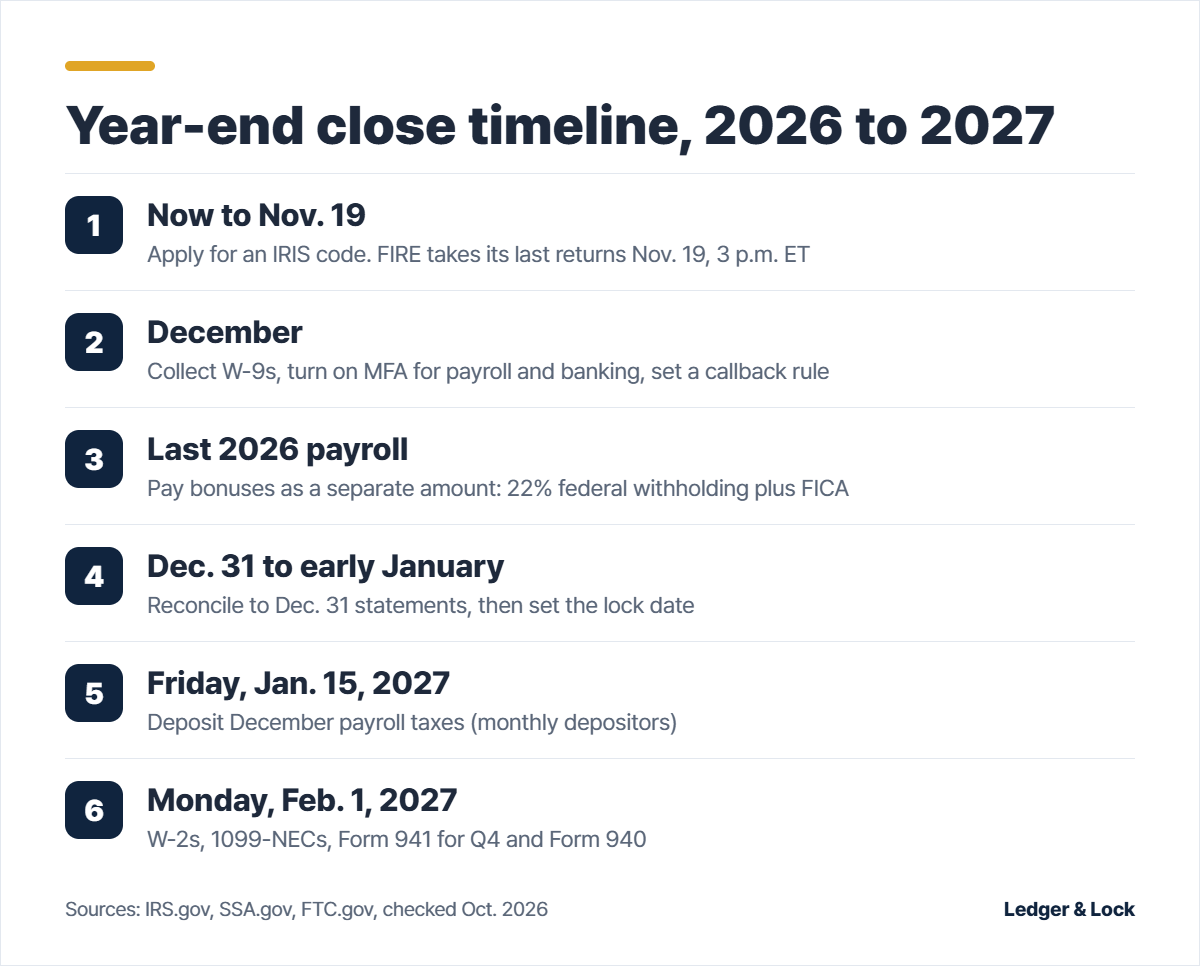
The order in brief: close and lock the books, run bonuses through the last 2026 payroll, prepare 1099-NECs, lock down payroll and accounting logins, and then file what is due on February 1. Switching accounting software in January is an optional sixth step.
The steps follow the order the work depends on. Reconciled books give you clean payroll and vendor totals. Payroll produces the W-2s, the vendor ledger produces the 1099s, and all of it sits behind logins that should be locked down before January. The steps are grouped below by when the work happens. Each one gives the short version, with the date or number that matters and its official source (checked October 24, 2026), and then points to the full walkthrough on this site.
How to use this small business year end checklist
Work through the steps in order, but start the slow items early. Two of them run on someone else’s clock: an IRS e-file account for 1099s, and W-9 forms from contractors who answer email slowly. Both belong on your calendar before Thanksgiving if you can manage it.
This guide covers federal rules for a calendar-year business with W-2 employees, outside contractors, or both. It leaves out state payroll and state 1099 filing, sales tax returns, inventory counts, and the income tax return itself. Your state revenue and labor departments set those rules, and your tax preparer owns the return.
To keep the numbers concrete, a few steps refer to one invented business. Hypothetical example: Bayside Frame Co. is a framing shop with six W-2 employees and four freelance installers, each paid more than $2,000 in 2026. It runs payroll in software and keeps its books in QuickBooks Online.
Before the year ends: the books and the bonuses
Step 1: Close and lock the books (Dec. 31 to early January)
Reconcile every bank and credit card account through its December 31 statement before anything else, because every later figure comes out of those balances. Then clear or explain old uncleared checks, write off invoices you know will never be paid, and set a lock date once your preparer’s adjustments are in, so nobody edits 2026 by accident. QuickBooks Online and Xero both have a closing-date setting for exactly this.
Two details trip people up this year. The IRS standard mileage rate page lists two business rates for 2026: 72.5 cents per mile for January through June and 76 cents for July through December, so one annual total multiplied by one rate will be wrong. Locking the books also does not mean shredding paper. The IRS page on how long to keep records says to keep most records for 3 years after filing and employment tax records for at least 4 years after the tax is due or paid.
The year-end bookkeeping checklist with a worked example follows a hypothetical sign shop through the whole close, including a reconciliation that was off by $87.25 and the menu paths for setting a lock date in both programs.
Missing receipts slow the close more than almost anything else. IRS Publication 463 expects each expense record to show the amount, date, place and business purpose, and it says a canceled check by itself does not prove a business expense. If your team still hands in paper at the end of the month, the receipt tracking app for small business guide compares four apps against those rules, so receipts can be captured before the December card charges pile up.
Small equipment bought in December needs one more decision. Items up to $2,500 per invoice or per item can be deducted under the de minimis safe harbor only if your books already expense them under a procedure in place on January 1 and you attach an election statement to the return; the de minimis safe harbor election statement walkthrough sorts one shop’s December invoices and gives the wording.
Step 2: Run year-end bonuses through payroll (by the last 2026 payroll)
A bonus paid in December is 2026 wages and belongs on the 2026 W-2, so settle the amounts before your final payroll run of the year. When the bonus is identified separately from regular pay, IRS Publication 15 (2026) allows a flat 22% rate for federal income tax withholding. Social Security at 6.2% and Medicare at 1.45% still apply on top, from the employee and again from you.
For a hypothetical $500 bonus in a state with no income tax, that works out to $110.00 of federal withholding, $38.25 of employee Social Security and Medicare, and a check for $351.75. Your matching share brings the cost to $538.25. Monthly depositors owe the taxes on December payments by the 15th of the next month, per the IRS employment tax due dates page, which makes it Friday, January 15, 2027.
The holiday bonus tax rate example runs six bonuses through payroll at a hypothetical bakery, shows how to gross up a bonus so each person nets an even $500, and explains why gift cards go through payroll as wages.
Gifts to clients sit outside payroll and under a much tighter federal cap: IRS Publication 463 allows a deduction of $25 per recipient per year for business gifts, while a party for your own staff can be fully deductible. Sort December’s gift baskets, client dinners and staff party receipts with the client gift deduction limit guide before the books close, since each lands in a different bucket on the return.
The last payrolls of the year also run into two bank holidays. Christmas Day (December 25) and New Year’s Day (January 1, 2027) both fall on a Friday, so a Friday payday on either date moves a day earlier, and the run has to be submitted earlier as well; with a two-day lead, the New Year’s run is due Tuesday, December 29. Our ACH bank holidays 2026 guide lists the submit-by date for each remaining closure.
Christmas week brings one more payroll check for hourly staff. Under the FLSA a paid day off at Christmas adds pay but no hours worked, so it does not move anyone toward 40 hours of overtime unless your setup counts paid hours; the guide to whether holiday pay counts toward overtime walks through a hypothetical store’s week, the premium-pay exceptions and a calculator.
S corporation owners have one more item for that final run. Health insurance premiums the company paid for a shareholder who owns more than 2% of the stock go in box 1 of that owner’s W-2 but stay out of boxes 3 and 5, per the IRS instructions for Forms W-2 and W-3, and they have to be reported for the year they were paid. The S corp shareholder health insurance W-2 walkthrough follows $14,400 of premiums through each box and explains what to tell your payroll provider before December closes.
Company cars and vans belong in that same final payroll. Personal use of a company vehicle is taxable pay in boxes 1, 3 and 5, and Publication 15-B lets you value it at fair market value or with the commuting rule ($1.50 each way), the cents-per-mile rule (72.5 cents a mile for 2026) or lease value. The personal use of company vehicle on W-2 example runs one hypothetical service company’s four vehicles through those rules.
Owners who pay home office rent and utilities out of pocket can move those costs onto the company books the same month. Under Publication 15’s accountable plan rules, the S corporation can repay the business share without treating it as wages, as long as each cost is substantiated and any excess is returned within a reasonable period. The accountable plan for S corp home office costs guide works one owner’s December reimbursement through those rules.
Before the last payroll of the year is also a good time to price next year’s. At workplaces under 50 people, BLS measured $9.76 of benefits for every $27.88 of wages in June 2026, about 35 cents per wage dollar, and $2.97 of that hour went to legally required costs such as Social Security, Medicare and unemployment tax. The breakdown of what an employee costs beyond salary at a small business compares industries and walks a $20 hire through the math.
Contractor forms and logins to start now
Step 3: Prepare 1099-NECs now (November and December)
For payments made in 2026, the reporting threshold for nonemployee pay rose from $600 to $2,000 per payee, according to the current IRS instructions for Forms 1099-MISC and 1099-NEC. The same instructions say the figure may be adjusted for inflation starting in 2027, so check it again next year. Pull a vendor payment report for January 1 through today, mark everyone at $2,000 or more, and request a Form W-9 from anyone whose form you lack.
The filing system is changing at the same time. According to the FIRE system page on IRS.gov, November 19, 2026, at 3 p.m. Eastern is the last day to file through FIRE, and IRIS becomes the only information return e-file system after January 1, 2027. The free IRIS Taxpayer Portal handles up to 100 returns at a time but needs its own Transmitter Control Code, so apply soon if you plan to file yourself.
Count your forms, too. Bayside Frame Co. has 6 W-2s and 4 Forms 1099-NEC, which makes 10 information returns. W-2s count toward that total, and at 10 returns electronic filing becomes mandatory. The 1099-NEC prep guide for 2026 payments sorts a sample vendor list into “form” and “no form” and compares IRIS, payroll software, and paper filing.
If you pay contractors through a bill pay tool, check what it charges for January’s 1099s before the filing run. On the vendor pages read November 1, 2026, BILL listed $2.99 per 1099 e-filed with the IRS and $1.99 per form mailed to the vendor, while QuickBooks Bill Pay’s Premium and Elite plans included unlimited 1099 e-filing with printing and mailing. The Melio vs Bill.com vs QuickBooks Bill Pay fee comparison adds those form fees to a month of vendor payments for a hypothetical HVAC shop with 12 subcontractors.
Before anyone lands on the 1099 list, confirm the person is a contractor at all. The IRS weighs behavioral control, financial control and the type of relationship, and neither a contractor agreement nor the 1099 decides it. The independent contractor vs employee guide works through those tests, the Labor Department’s separate test, and the cost of reclassifying in a hypothetical studio.
Step 4: Lock down payroll and accounting logins (December)
January is when payroll staff pass W-2 data around, and that is what the W-2 scam targets. An IRS.gov page on Form W-2/SSN data theft describes the pattern: an email that appears to come from an executive asks payroll or HR for a list of employees and their Forms W-2. A business that sent the data should email dataloss@irs.gov, and one that only received the message should forward it to phishing@irs.gov.
Before then, turn on multi-factor authentication for the accounts that hold money or employee data: payroll, accounting, banking, and the mailbox of anyone who approves payments. The FTC’s cybersecurity guidance for small businesses tells owners to require multi-factor authentication to protect sensitive information. Then write down one rule: nobody sends W-2 files or changes a vendor’s bank details on the strength of an email; they call back on a number already on file.
The small business MFA setup checklist covers which method to choose for each account and how to roll it out without locking anyone out. For the payment side, the guide on how to prevent business email compromise explains the callback rule in detail and what to do in the first hour if a payment goes to the wrong account.
Back up the closed books before January as well. Once December is locked, the 2026 accounting file and payroll reports become the records you file from, and a single laptop or a synced cloud folder can lose them to one ransomware attack. The small business data backup plan built on the 3-2-1 rule covers keeping three copies on two kinds of storage with one offline, plus a restore drill you can run in an afternoon.
January: the filing deadlines and an optional software switch
Step 5: Meet the January filing deadlines (Jan. 15 to Feb. 1, 2027)
Every January 31 deadline below moves to Monday, February 1, 2027, because the IRS shifts due dates that fall on a weekend to the next business day. The 2026 General Instructions for Forms W-2 and W-3 put the SSA filing date at February 1, 2027, on paper or electronically, and add that W-2 extensions are not automatic: you can request one 30-day extension, and only by application.
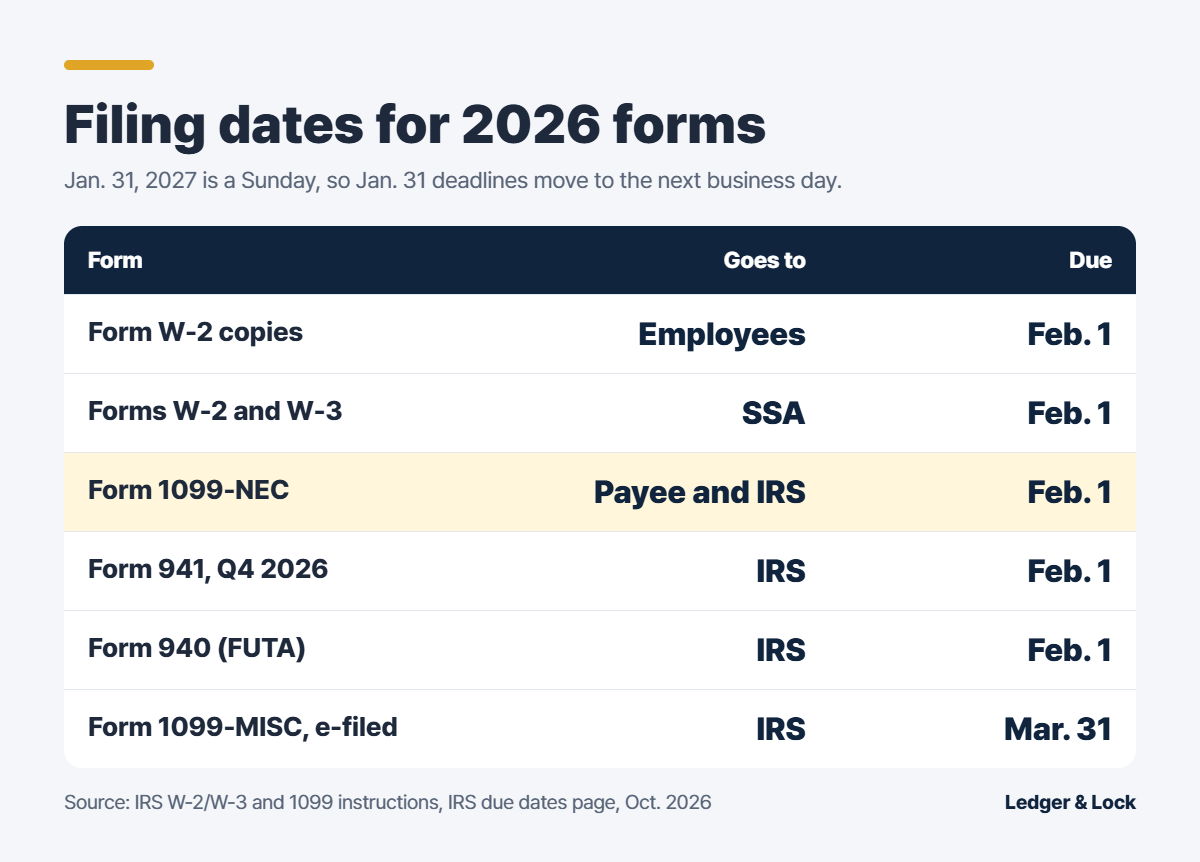
The dates in order, with the official source for each:
- Friday, January 15, 2027: tax deposit for December payroll, for monthly depositors (IRS employment tax due dates).
- Monday, February 1, 2027: three filings land together. Form W-2 copies go to employees, and Forms W-2 and W-3 to the SSA (IRS W-2/W-3 instructions). Form 1099-NEC goes to recipients and to the IRS (IRS 1099-MISC/NEC instructions). Form 941 for Q4 2026 and Form 940 for 2026 FUTA are due the same day, with 10 extra days if every deposit was on time (IRS employment tax due dates).
- March 1, 2027 on paper, or March 31, 2027 e-filed: Form 1099-MISC to the IRS, such as for rent paid (IRS 1099-MISC/NEC instructions).
January 31, 2027 is a Sunday. W-2s, 1099-NECs, the fourth-quarter Form 941 and Form 940 are all due Monday, February 1, 2027.
Two box 12 codes are new on the 2026 Form W-2: code TT for qualified overtime pay and code TP for cash tips. Payroll has to track both amounts before the last December run, because the W-2 can only report what the payroll records hold. The W-2 box 12 code TT and TP walkthrough fills in the boxes for three hypothetical diner employees and shows how to fix a W-2 that already went out without them, using Form W-2c.
Update payroll for the new year before the first January check. The Social Security Administration’s contribution and benefit base table shows the 2027 wage base at $192,300, up from $184,500 for 2026, so the 6.2% tax keeps running longer for your highest earners. Late or wrong information returns draw a penalty per form, charged separately for the IRS copy and the recipient copy; the per-form amounts are in the deadline section of the 1099-NEC guide.
Form 940 has one extra wrinkle for employers with California payroll. California is the only FUTA credit reduction state for 2026, at 1.5%, which adds $105 for each California employee who earned at least $7,000, and the IRS treats that amount as fourth-quarter tax due with the deposit and Form 940 at the start of February 2027. The FUTA credit reduction guide for 2026 shows the Schedule A lines and what a mixed-state payroll enters.
Sole proprietors have one more January date: the fourth estimated tax payment, due Friday, January 15, 2027, figured on Schedule C net profit. IRS data for tax year 2023 show 68.8% of the 31.1 million Schedule C returns with a profit and margins from 39.7% in professional services down to 1.9% in food service; our sole proprietorship statistics by industry show where a business sits against its sector before that payment is set.
Step 6 (optional): Pick next year’s accounting software in January
If this close took far longer than it should have, January 1 is the cleanest point to switch. The opening balances in the new system are simply your locked December 31 balances, and you avoid splitting one tax year across two programs. Decide before anyone starts entering 2027 transactions, and keep access to the old file or a full export so 2026 records stay reachable for the retention periods in step 1.
Price the options by logins before features. On the vendors’ US pricing pages as checked October 21, 2026, QuickBooks Online and Zoho Books capped users on each plan, while Xero said it charges no per-user fees; with four people who need their own login, that rule pushed QuickBooks to its $140-a-month Plus plan. The QuickBooks vs Xero pricing comparison has the plan-by-plan table and a worked monthly bill for a 5-person team, with Zoho Books as a third option. Prices change often, so confirm them on the vendor pages before you commit.
Solo owners who mostly send invoices have a lighter choice than a full accounting plan. On the vendors’ pages as read October 29, 2026, the FreshBooks, Wave and QuickBooks Solopreneur plans that fit a one-person designer cost $0 to $43 a month, while online payment fees on a sample $9,600 month came to roughly $210 to $215 at each. The FreshBooks vs Wave vs QuickBooks Solopreneur comparison lines up those plans and fees and includes a calculator for your own month.
A sole proprietor’s January 15 estimated-tax payment belongs beside the year-end filing work, but the payment amount uses different records. Compare the prior-year tax, expected current-year tax, and amounts already paid before scheduling it. The safe-harbor estimated-tax calculation for Q4 follows one hypothetical contractor and separates the payment target from earlier-quarter penalty timing.
What to do this week
Open your vendor payment report for January 1 through today, sort it by total paid, and highlight everyone at $2,000 or more. That one list tells you who still owes you a W-9, whether you will reach the 10-return e-file count, and whether the IRIS application has to go in this week.
This guide is general information about federal rules, not tax, legal, or IT security advice for your business. State payroll and 1099 rules differ, so check your state revenue department as well, and see IRS.gov Small Business and Self-Employed for federal guidance.
Leave a Reply